Chapter 13: Earth as a System: Energy, Matter, and Life
Verified step-by-step solutions for your class notes.
Choose the most appropriate option to describe the role of biogeochemical cycles in an ecosystem.
(i) To provide food directly to all organisms.
(ii) To recycle essential nutrients between biotic and abiotic components.
(iii) To create new elements for use by living things.
(iv) To remove pollutants and toxins from the organism.
- Correct Option: (ii) To recycle essential nutrients between biotic and abiotic components.
- Explanation: Biogeochemical cycles circulate finite natural resources like carbon, nitrogen, oxygen, and water through the living (biotic) and non-living (abiotic) elements of the planetary system, ensuring they remain constantly accessible to sustain life.
Which of the following is primarily responsible for warming of the Earth?
(i) Solar radiation is immediately absorbed by carbon dioxide, which then releases it as heat.
(ii) The atmosphere's tiny particles absorb incoming solar radiation.
(iii) The Earth's surface absorbs solar radiation, which is then re-radiated and trapped by greenhouse gases.
(iv) The Earth's environment is heated only by the solar radiation reflected by the clouds.
- Correct Option: (iii) The Earth's surface absorbs solar radiation, which is then re-radiated and trapped by greenhouse gases.
- Explanation: Incoming shortwave solar radiation passes through the clear atmosphere and is absorbed by the surface. The warmed ground then re-radiates this thermal energy as longwave infrared radiation, which is intercepted and retained by greenhouse gases like carbon dioxide, methane, and water vapour.
Explain how climate change affects the water cycle. Illustrate with examples.
- Core Impact: Rising global atmospheric temperatures accelerate evaporation and expand the capacity of the air to store moisture, leading to severe disruptions in precipitation and runoff trends.
- Example 1 (Intensified Monsoons & Droughts): Higher thermal energy increases water vapour storage, fueling cloud bursts and flooding rains in specific regions (such as an unpredictable, intense southwest monsoon in India), while leaving other inland zones trapped in severe droughts.
- Example 2 (Glacial Melt & Groundwater Loss): Rising temperatures accelerate the melting of critical mountain glaciers, temporarily bloating rivers but lowering dry-season flows in the long run. Additionally, sudden heavy downpours generate rapid surface runoff that leads to soil erosion instead of trickling down to recharge vital underground aquifers.
Describe how albedo affects the Earth's surface temperature and its climate.
- Albedo Function: Albedo measures the fraction of incoming solar radiation that a surface reflects back out into space. It directly dictates how much thermal energy the planet retains.
- High Albedo Impact: Light-colored surfaces like snow (0.80–0.90) and ice bounce most sunlight back, keeping polar areas cold. However, when global warming melts this ice, it reveals dark ocean water below.
- Low Albedo Impact: Dark surfaces like open oceans or black soils have low albedo values. They absorb the vast majority of incoming solar rays and convert them to heat. This creates a warming loop: less ice leads to more absorption, raising local temperatures and accelerating further climate shifts.
How are mountain and valley breezes formed? Suppose there are two mountains, one covered with grass and another covered with barren rocks; would the temperature of the two mountain breezes be different? If so, how?
- Formation Process: During the day, mountain slopes heat up quickly under sunlight, causing the air over them to rise and drawing cooler air up from the valley floor as a valley breeze. At night, the slopes radiate heat away rapidly, making the air cold and dense so it sinks down into the valley as a mountain breeze.
- Breeze Variation: Yes, the mountain breeze coming off the barren rock mountain will be noticeably different than the one from the grass-covered mountain.
- Thermal Contrast: Barren rock has a low albedo and high thermal mass, meaning it absorbs a massive amount of solar energy during the day and re-radiates it intensely at night. Grass surfaces stay significantly cooler due to vegetation shade and moisture loss from plant transpiration. As a result, the nighttime breeze moving down the barren rock mountain will start warmer and transfer more re-radiated heat down into the valley floor.
You have witnessed weather phenomena, such as winds, storms, rainfall, etc. Which atmospheric layer is mainly responsible for such phenomena and what is the primary reason for its occurrence?
- Responsible Layer: The Troposphere (extending from ground level up to roughly 12 km).
- Primary Reason: The troposphere is heated from the ground up by the Earth's surface, causing temperature to drop steadily with altitude (~6.5°C/km). This vertical temperature difference forces warm, moist air to rise and cold air to sink, driving convection currents, storm formations, and active cloud precipitation.
Explain the processes involved in the nitrogen cycle. How would life on Earth be affected if nitrogen were not cycled?
- Cycle Processes:
• Fixation: Bacteria like Rhizobium convert unreactive atmospheric N2 into ammonia.
• Nitrification: Soil microbes turn ammonia into nitrites and usable nitrates.
• Assimilation: Plants absorb these nitrates to build vital biological proteins.
• Ammonification: Decomposers break down dead matter, returning ammonia to the soil.
• Denitrification: Specific bacteria convert excess nitrates back into N2 gas. - Impact of Cycle Failure: If this loop stopped, structural nitrogen would remain locked in dead organic waste or stay trapped as unreactive gas in the atmosphere. Plants would be unable to absorb nutrients, halting the production of essential amino acids, proteins, and DNA across all trophic layers and triggering a total crash of global food webs.
What are the impacts of deforestation on the Earth's oxygen and carbon cycles? What are the other consequences of deforestation?
- Impact on Cycles: Stripping away large forest systems reduces photosynthesis, which cuts down on global oxygen generation and slows the removal of CO2 from the air. Burning or leaving cut trees to decay releases large amounts of stored carbon back into the atmosphere, directly altering the greenhouse balance.
- Other Consequences: Deforestation reduces local plant transpiration, which can cause regional rainfall to decline and disrupt the water cycle. It alters the land's surface albedo, and removes the root networks that hold topsoil together, leading to severe soil erosion and widespread habitat loss across the biosphere.
Explain with suitable diagram the path that carbon takes to go back to the atmosphere. You may start from plants using CO₂ from the atmosphere.
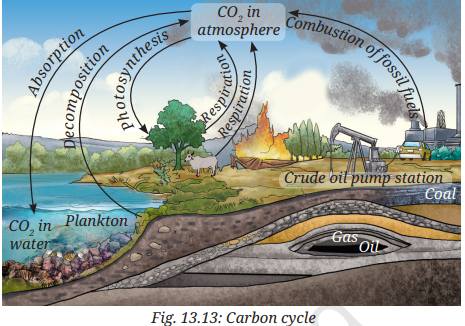
- Carbon Pathways: Plants first absorb CO2 from the atmosphere to manufacture sugars through photosynthesis. This carbon then takes three main paths back into the air:
- Respiration: Both the plants and the consumers that eat them break down these sugars for energy, directly breathing CO2 back into the air.
- Decomposition: When these organisms die, micro-decomposers break down their remains, releasing carbon back into the atmosphere.
- Combustion: Organic matter buried over millions of years turns into fossil fuels (coal, oil, gas). When humans extract and burn these fuels for industrial energy, that stored carbon is released back into the atmosphere on a very short time scale.
Why is an excess of CO₂ in the atmosphere considered undesirable even though it is required by plants?
- Core Problem: While plants use CO2 for basic photosynthesis, human emissions have completely overwhelmed the capacity of natural carbon sinks to absorb it.
- Systemic Side Effects: This excess gas traps too much re-radiated infrared heat, intensifying the greenhouse effect. This drives global warming, melts critical glaciers, and leads to rising sea levels that threaten coastal cities. It also makes oceans more acidic as they absorb the extra gas, which harms coral reefs and disrupts global farming systems through unpredictable weather.
How is heat lost from the surface of the Earth? What is its significance?
- Loss Mechanism: The Earth's surface cools down by re-radiating absorbed solar energy back out toward space as longwave infrared radiation. Heat is also transferred vertically through the air via convection currents and latent heat exchange during water evaporation.
- Climatic Significance: This cooling balancing act prevents solar energy from building up indefinitely. By interacting with greenhouse gases that temporarily trap a portion of this outgoing infrared energy, it maintains a stable, mild global temperature that allows life to thrive.
If the Earth were a flat disc instead of a sphere, how would the patterns of solar radiation and temperature be different?
- Hypothetical Changes: If the Earth were a flat disc facing the Sun directly, solar rays would strike the entire surface at the exact same perpendicular angle.
- Scientific Consequences: This uniform angle would distribute solar energy evenly across the planet, erasing the natural temperature drop we see from the warm equator to the freezing poles. Without these heating differences, the planet would lose the pressure systems that drive global winds, planetary wind belts, and ocean currents, flattening out global weather systems entirely.
Suppose there is a rise in atmospheric temperature on Earth. How would this affect the cryosphere, hydrosphere and biosphere?
- Cryosphere Link: Warmer air temperatures accelerate the melting of mountain glaciers, ice sheets, and polar sea cover, rapidly shrinking the planet's ice reserves.
- Hydrosphere Link: This melting ice dumps vast amounts of freshwater into the oceans, which changes water salinity and drives up global sea levels. Warmer ocean waters also evaporate faster, overloading the atmosphere with moisture and intensifying storms.
- Biosphere Link: Rapidly changing habitats force land and marine species to adapt or face decline, disrupting fragile food webs. Shifting rainfall patterns directly threaten crop yields, while warming oceans can trigger widespread coral bleaching.
Explain how the Earth's atmosphere helps in maintaining a suitable temperature for life to survive on the Earth.
- Atmospheric Regulation: The atmosphere acts as a two-way thermal shield. During the day, it absorbs and scatters a portion of incoming solar rays, while the ozone layer blocks dangerous UV radiation, keeping the surface from overheating.
- Greenhouse Insulation: At night, the warmed surface re-radiates this energy out as infrared light. Greenhouse gases like carbon dioxide and water vapour trap a portion of this heat instead of letting it escape into space. This insulation keeps the planet from plunging into freezing temperatures, maintaining a stable climate where life can survive.
Describe the interrelationship between different spheres of the Earth. Illustrate with example how these spheres function in a delicate balance.
- Interconnected System: The Earth functions as a single unified system where the geosphere, hydrosphere, cryosphere, atmosphere, and biosphere are constantly linked through moving matter and energy loops.
- Illustrative Example: Consider how winter snowfall in the mountains connects these spheres. A drop in winter snow (cryosphere) reduces the volume of freshwater feeding mountain lakes and streams during the summer (hydrosphere). This water shortage leaves less moisture in the surrounding soil (geosphere), which stunts grass growth and reduces food available for grazing herds (biosphere). This shows how a shift in one sphere triggers a domino effect across the entire system.