Chapter 2: Cell: The Building Block of Life
Verified step-by-step solutions for your class notes.
Q1
Differentiate between the following pairs of terms based on the clues given in parentheses:
"i) Cell membrane and cell wall: Cell membrane is selectively permeable while cell wall is completely permeable.
(ii) RER and SER: Rough endoplasmic reticulum is rough in texture because of the presence of ribosomes on it while smooth endoplasmic reticulum is comparatively smooth because of absence of ribosomes on it.
(iii) Chloroplast and chromoplast: Chloroplast contains chlorophyll, the green pigment present in plants while chromoplast contains other pigments apart from green which help in providing colourful appearance to flowers and fruit"
Q2
Two similar animal cells are placed in two different solutions:
Cell X is placed in pure water.
Cell Y is placed in a concentrated salt solution.
Cells are observed after some time. Cell X swells, and Cell Y shrinks. Which statement provides the correct explanation for the above observations?
(i) Salt molecules moved into Cell Y, causing it to shrink.
(ii) Water moved into Cell X and more water moved out of Cell Y than the salt solution entered in it.
(iii) Water moved into Cell X and moved out of Cell Y through the cell membrane.
(iv) Solute movement caused osmosis in both cells.
(iii) Water moves into Cell X and moves out of Cell Y through the cell membrane.
Reason: Pure water is hypotonic, so water enters Cell X by osmosis and makes it swell. The salt solution is hypertonic, so water comes out of Cell Y, causing it to shrink.
Q3
. Look at the diagram of a cell in Fig. 2.20. Identify the parts labelled from (a) to (g) and correctly match them with their functions given below:
(i) Controlling all the activities of a cell.
(ii) Site of cellular respiration.
(iii) Storage organelle that also provides rigidity to the cell.
(iv) Separates the cell contents from surroundings.
(i) Controlling all the activities of a cell.
(ii) Site of cellular respiration.
(iii) Storage organelle that also provides rigidity to the cell.
(iv) Separates the cell contents from surroundings.
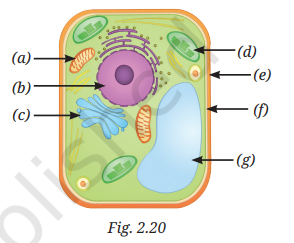
The labelled parts are
(a) Mitochondria → (ii) Site of cellular respiration.
(b) Nucleus → (i) Controls all the activities of a cell.
(c) Golgi apparatus → (vi) Packs and stores materials received from ER.
(d) Chloroplast → (vii) Helps in manufacturing food.
(e) Cell membrane → (iv) Separates the cell contents from the surroundings.
(f) Cell wall → (v) Provides structural rigidity to the cell.
(g) Vacuole → (iii) Acts as a storage organelle and also provides rigidity to the cell.
Answer: (a)–(ii), (b)–(i), (c)–(vi), (d)–(vii), (e)–(iv), (f)–(v), (g)–(iii)
Q4
Which of the following option(s) of the pairs of cell organelles are correctly placed under the given categories?
| Option | Present in the plant cells | Absent in the animal cells |
|---|---|---|
| (i) | Leucoplast | Cell wall |
| (ii) | Mitochondria | Ribosome |
| (iii) | Cell wall | Golgi apparatus |
| (iv) | Lysosome | Endoplasmic reticulum |
The correct answer is **(i)**.
Leucoplasts are present in plant cells, while the cell wall is absent in animal cells. The other options are incorrect because the organelles listed as absent in animal cells are actually present in them.
Q5
Two students, Renu and Rohit, were having a discussion on the plastids. Renu emphasised that all parts of the plants, even roots, contain plastids. However, Rohit did not agree with the statement and told her that plastids are absent in plant roots since the roots are underground and do not need to perform photosynthesis. Who is correct? Justify your answer
Renu is correct.
Justification: Plastids are present in almost all plant cells, including roots. While chloroplasts (for photosynthesis) are absent in roots because they receive no sunlight, underground roots contain leucoplasts (a type of non-green plastid) that function to store food materials like starch, oils, or proteins (e.g., in potato and taro roots).
Justification: Plastids are present in almost all plant cells, including roots. While chloroplasts (for photosynthesis) are absent in roots because they receive no sunlight, underground roots contain leucoplasts (a type of non-green plastid) that function to store food materials like starch, oils, or proteins (e.g., in potato and taro roots).
Q6
Mitochondria and chloroplasts are two important organelles in a plant cell. Discuss how these two organelles are structurally and functionally similar to each other, and different from each other.
Similarities
- Double membranes: Both are wrapped in two layers of membrane instead of just one.
- Their own genetic kit: Both contain their own DNA and ribosomes, allowing them to make some of their own proteins independently.
- Energy focus: Both function as energy converters inside the cell.
Differences
- Role: Chloroplasts make food using sunlight (photosynthesis), while mitochondria break down food to release usable energy for the cell (respiration).
- Location: Chloroplasts are only found in plant cells and algae, whereas mitochondria are present in both plant and animal cells.
Internal structures: Chloroplasts contain green chlorophyll and stack-like structures called thylakoids, while mitochondria have a deeply folded inner membrane called cristae to maximize surface area.
Q7
Which of the following pairs of cell organelles contains DNA?
(i) Chloroplasts, Ribosomes
(ii) Mitochondria, Nucleus
(iii) Golgi bodies, Ribosomes
(iv) Nucleus, Lysosomes
(i) Chloroplasts, Ribosomes
(ii) Mitochondria, Nucleus
(iii) Golgi bodies, Ribosomes
(iv) Nucleus, Lysosomes
Correct Option: (ii) Mitochondria, Nucleus
Q8
A researcher carried out an experiment in which she took two carrots of similar size. She placed one carrot in plain water and the other carrot of similar size. She placed one carrot in plain water and the other carrot observations.
(i) What hypothesis does she want to test through this experiment?
(ii) What would you suggest for the improvement of this experiment?
(iii) Why does the carrot in plain water stay stiff and crunchy, but the carrot in concentrated salt solution become rubbery and limp?
(i) What hypothesis does she want to test through this experiment?
(ii) What would you suggest for the improvement of this experiment?
(iii) Why does the carrot in plain water stay stiff and crunchy, but the carrot in concentrated salt solution become rubbery and limp?
(i) She wants to test how water moves into or out of living plant cells by osmosis based on the concentration of the liquid outside.
(ii) She wants to test how water moves into or out of living plant cells by osmosis based on the concentration of the liquid outside.
(iii) In plain water: The liquid outside has more water than inside the carrot cells. Water enters the carrot cells by osmosis. This fills up the vacuoles and pushes against the cell wall (turgor pressure), keeping the carrot firm and crisp.
In salt solution: The liquid outside is more concentrated, so it has less water than inside the carrot cells. Water flows out of the carrot cells into the salt water. The cells lose pressure and shrink away from their walls, making the carrot soft and rubbery.
Q9
Indicate the presence or absence of following structures in bacterial and animal cells:
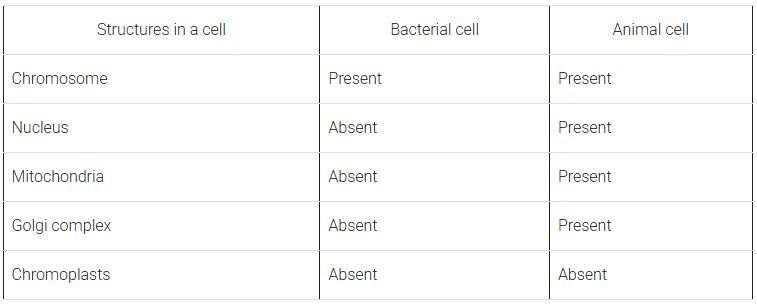
The answer is given in the table
Q10
Carry out the following experiment:
Take four peeled potato halves and scoop each one out to make potato cups. One of these potato cups should be made from a boiled potato. Place each of the potato cups in a beaker containing water (Fig. 2.22).
Now, set up the experiment as follows:
(a) Keep Cup A empty.
(b) Add one teaspoon sugar in Cup B.
(c) Add one teaspoon salt in Cup C.
(d) Add one teaspoon sugar in the boiled potato in Cup D.
Observe the four potato cups at least two hours and answer the following questions:
(i) Explain why water gathers in the hollowed portion of Cup B and Cup C.
(ii) Why is Cup A necessary for this experiment?
(iii) Explain why water does not gather in the hollowed portions of Cups A and D.
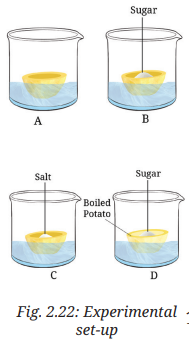
(i) Why does water accumulate in the hollowed part of B and C?
The water accumulates by means of osmosis. When sugar or salt is added in the cup, the concentration of this region becomes greater than the concentration of the normal water in the trough. The water accumulates naturally through the living potato cell membranes in order to reduce the concentration of sugar and salt.
(ii) Why is potato A used in this investigation?
Potato A is needed for control purposes. This is because it shows that water does not accumulate in the hollowed potato itself but a solute like sugar or salt is required.
(iii) Why doesn’t water accumulate in the hollowed part of A and D?
For potato A: No sugar or salt is added inside the hollowed part of this potato. Hence, there is no concentration gradient to accumulate water.
For potato D: The boiling process destroys the cells and thus the membranes are destroyed. Thus, osmosis cannot take place due to lack of living selectively permeable membranes.
Q11
Identify the pair that incorrectly matches the cell organelle with its function.
(i) Ribosome — Protein synthesis
(ii) SER — Lipid and cellulose synthesis
(iii) Lysosome — Digestion of foreign agents
(i) Ribosome — Protein synthesis
(ii) SER — Lipid and cellulose synthesis
(iii) Lysosome — Digestion of foreign agents
Answer: (ii) SER — Lipid and cellulose synthesis
Reason: The Smooth Endoplasmic Reticulum (SER) plays a role in the synthesis of lipids (fats) and hormones, while cellulose is produced by plant cells to construct the cell wall.
Reason: The Smooth Endoplasmic Reticulum (SER) plays a role in the synthesis of lipids (fats) and hormones, while cellulose is produced by plant cells to construct the cell wall.
Q12
What outcome do you expect, if all the mitochondria are removed from a eukaryotic cell?
Mitochondria are known as the "cell's powerhouses," tasked with producing ATP via cellular respiration. Without any mitochondria, the cell cannot generate enough energy (ATP) necessary for vital biological activities and metabolic functions, resulting in cell impairment and eventually cell death.
Q13
Which phenomenon inhibits the formation of tumors in the human body? Can plants also develop tumors? Explain.
Phenomenon: Contact inhibition halts tumor development in humans by ceasing cell division upon contact with adjacent cells.
In plants: Plant cells do not exhibit contact inhibition because of their stiff cell walls. Nonetheless, plants can still form tumors or galls, frequently induced by pathogens such as viruses, bacteria (e.g., Agrobacterium), or fungi that provoke unchecked cell proliferation.
In plants: Plant cells do not exhibit contact inhibition because of their stiff cell walls. Nonetheless, plants can still form tumors or galls, frequently induced by pathogens such as viruses, bacteria (e.g., Agrobacterium), or fungi that provoke unchecked cell proliferation.
Q14
The cell membrane of a cell is made up of proteins and lipids. Which cell organelles help in the synthesis of cell membrane? Write the path of these compounds from their site of synthesis to the cell membrane and show this through a labelled diagram.
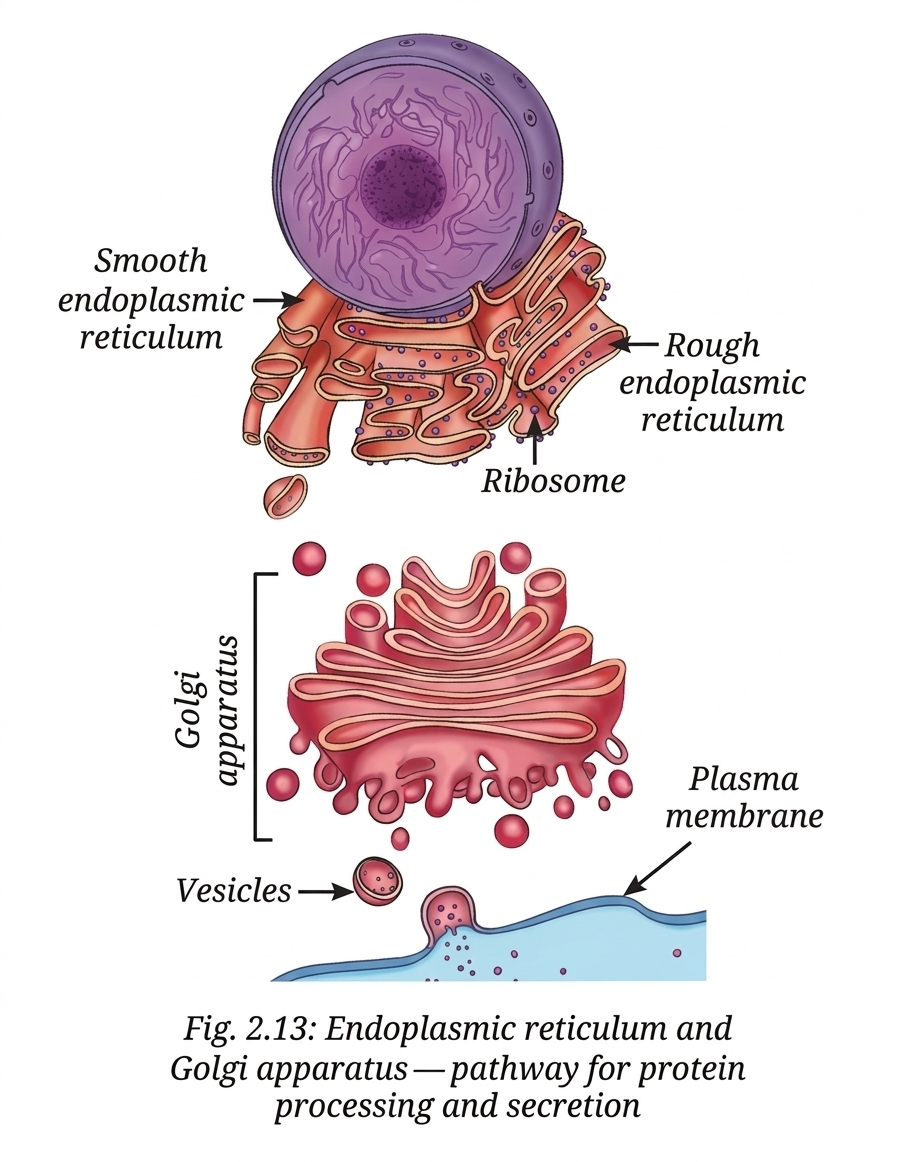
The Endoplasmic Reticulum is crucial for lipid and protein synthesis. Smooth endoplasmic reticulum (SER) and rough endoplasmic reticulum (RER) produce the lipids and proteins of the cell membrane, respectively. The Golgi apparatus processes, organizes, and encases them in vesicles for transport.
Route:
Nucleus → SER/RER (Lipid/protein synthesis) → Transport Vesicle → Golgi Apparatus (Modification and packaging) → Secretory Vesicles → Plasma Membrane
Route:
Nucleus → SER/RER (Lipid/protein synthesis) → Transport Vesicle → Golgi Apparatus (Modification and packaging) → Secretory Vesicles → Plasma Membrane
Q15
What would happen if gametes are formed by mitotic divisions?
If gametes were created through mitotic divisions instead of meiosis, they would be diploid (2n) instead of haploid (n). When two gametes of this kind combine during fertilization, the zygote will become tetraploid (4n).
In the subsequent generation, this doubling would persist, resulting in 8n, 16n, 32n, and so on. The cells would grow genetically unstable, becoming excessively large to operate correctly, and species survival would be challenging due to fatal chromosome imbalances. Genetic diversity would also diminish because mitosis creates identical replicas without any recombination.
In the subsequent generation, this doubling would persist, resulting in 8n, 16n, 32n, and so on. The cells would grow genetically unstable, becoming excessively large to operate correctly, and species survival would be challenging due to fatal chromosome imbalances. Genetic diversity would also diminish because mitosis creates identical replicas without any recombination.
Q16
A farmer, Deepa, was very happy with the harvest of amla (Indian Gooseberry) and lemons on her farm. However, she could sell only one-fourth of the produce in the local market. Recognising that a significant amount of produce may be lost post-harvest, she employed a traditional yet scientifically sound method to extend the shelf life of amla and lemons. She turned perishable produce into profitable products, such as pickles and sharbat. She used the excess produce to prepare pickles, murabbas, and sharbat by adding appropriate amounts of salt, sugar, or jaggery to small pieces of fruit and their juices. These were then stored in small glass bottles for sale, helping her prevent the wastage of post-harvest produce. This shift from farming to agro-processing would strengthen food security and boost the local economy, creating a sustainable model that cuts waste while increasing her income. Based on the above passage answer the following questions:
(i) Which scientific concept has the farmer applied in the preservation of the farm produce?
(ii) How does the addition of high concentrations of salt and sugar create an environment that prevents the growth of spoilage-causing bacteria and fungi?
(iii) Suggest a healthy recipe of this kind for food preservation.
(iv) What are the scientific values addressed in this case?
(i) The farmer utilized the concept of osmosis for preserving food.
(ii) Elevated levels of salt and sugar generate a hypertonic setting surrounding microorganisms. Water exits bacterial and fungal cells through osmosis, leading to dehydration that hampers their growth and stops spoilage.
(iii) Nutritious amla pickle recipe:
• Use 500 g of chopped amla.
• Incorporate 2 tbsp mustard oil, 1 tbsp turmeric, 1 tbsp red chili powder, 2 tbsp salt, and 1 tbsp jaggery (as a substitute for extra sugar).
• Warm the oil and incorporate spices, then combine it with amla. Place in a clean, dry glass jar and expose to sunlight for several days. This preserves vitamin C and inhibits microbial growth, while also improving its taste.
(iv) The scientific values discussed include resource conservation (zero waste), utilization of scientific principles (osmosis for preservation), sustainability (agro-processing for food security), innovation (traditional knowledge combined with science), as well as economic awareness and entrepreneurship.