Chapter 3: Tissues in Action
Verified step-by-step solutions for your class notes.
Q1
Meristematic tissues divide repeatedly. What property of their cells allows them to do this?
(i) They have thick walls for protection.
(ii) They contain large vacuoles that store nutrients.
(iii) They have thin walls, dense cytoplasm and large prominent nucleus.
(iv) They are functionally differentiated cells.
(i) They have thick walls for protection.
(ii) They contain large vacuoles that store nutrients.
(iii) They have thin walls, dense cytoplasm and large prominent nucleus.
(iv) They are functionally differentiated cells.
(iii) They have thin walls, dense cytoplasm, and large, prominent nucleus.
Q2
If a plant is unable to transport food from leaves to roots which tissue is malfunctioning?
(i) Xylem
(ii) Phloem
(iii) Epidermis
(iv) Sclerenchyma
(i) Xylem
(ii) Phloem
(iii) Epidermis
(iv) Sclerenchyma
(ii) Phloem
Q3
You can perform these two jumps (Fig. 3.21):
Straight-leg jump — keep knees and ankles stiff.
Normal jump — bend knees and ankles naturally.
How did your ankle, knee and hip positions differ between the two jumps?
Straight-leg jump — keep knees and ankles stiff.
Normal jump — bend knees and ankles naturally.
How did your ankle, knee and hip positions differ between the two jumps?
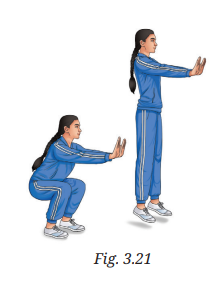
In a straight-leg jump, the ankle, knee, and hip joints stay rigid and aligned, resulting in minimal to no bending. During a typical jump, the knees, hips, and ankles flex organically. This aids in shock absorption, supports balance, and enhances movement and elevation while jumping.
Q4
Which type of joint is involved when you bend your knees and ankles?
(i) Ball and socket
(ii) Hinge
(iii) Pivot
(i) Ball and socket
(ii) Hinge
(iii) Pivot
(ii) Hinge
Q5
In each of the following cases (A, B, C and D), choose the correct option as given below:
(i) Both (A) and (R) are true, and (R) is the correct explanation of (A).
(ii) Both (A) and (R) are true, but (R) is not the correct explanation of (A).
(iii) (A) is true, but (R) is false.
(iv) (A) is false, but (R) is true.
A. Assertion: Epithelium is well-suited for gas exchange in the lungs.
Reason: It consists of multiple layers of tall cells that slow down diffusion.
B. Assertion: Cardiac muscle can contract continuously without fatigue.
Reason: Cardiac muscle cells have a high number of mitochondria and an abundant blood supply.
C. Assertion: Tendons connect bone to bone and allow joint movement.
Reason: Tendons are made of tough connective tissue that transmits force from muscle to bone.
D. Assertion: In a hinge joint, movement occurs primarily in one plane.
Reason: The bone ends are shaped to allow sliding in all directions.
A: (iii) (A) is true, but (R) is false.
B: (i) Both (A) and (R) are true, and (R) is the correct explanation of (A).
C: (iv) (A) is false, but (R) is true.
D: (iii) (A) is true, but (R) is false.
B: (i) Both (A) and (R) are true, and (R) is the correct explanation of (A).
C: (iv) (A) is false, but (R) is true.
D: (iii) (A) is true, but (R) is false.
Q6
Plot a graph between the age of a tree (in years) on the x-axis and the diameter of the tree (in cm) along with the number of annual rings formed over time on the y-axis, using the data given in Table 3.7.
Table 3.7: Data related to the age of a teak tree, and corresponding increase in the diameter of stem and number of annual rings
(i) Analyse the graph in terms of the diameter of the stem over time and share the interpretation.
(ii) What is the relation between the diameter of the teak tree to the annual rings formed?
(iii) Which specialised tissue is responsible for the girth of the stem and where is it located?
Table 3.7: Data related to the age of a teak tree, and corresponding increase in the diameter of stem and number of annual rings
| S. No. | Age of the teak tree (Years) | DBH (Diameter at Breast Height) of tree (cm) | Number of annual rings formed |
|---|---|---|---|
| 1. | 5 | 4 | 5 |
| 2. | 10 | 8 | 10 |
| 3. | 30 | 24 | 20 |
| 4. | 25 | 28 | 25 |
| 5. | 30 | 32 | 30 |
| 6. | 40 | 40 | 40 |
(i) Analyse the graph in terms of the diameter of the stem over time and share the interpretation.
(ii) What is the relation between the diameter of the teak tree to the annual rings formed?
(iii) Which specialised tissue is responsible for the girth of the stem and where is it located?
(i) Analysis of graph:
As the age of the tree increases, the diameter of the stem also increases. The increase is continuous over time, showing a steady growth in girth as the tree ages.
(ii) Relationship between diameter and annual rings:
There is a positive correlation between the diameter of the tree and the number of annual rings. As more annual rings are formed each year, the diameter of the teak tree expands continuously.
(iii) Specialised tissue and location:
Lateral Meristem (Vascular Cambium and Cork Cambium) is responsible for increasing the girth (secondary growth) of the stem. It is located in the lateral sides of the stem, specifically between the primary xylem and primary phloem.
Q7
Look at the given figure showing the debarked portion of a tree trunk. Answer the following questions based on the image:
(i) What is the immediate impact of removing the bark on the tree's defense?
(ii) Which tissue lies just below the bark, and how does its damage affect the plant?
(iii) What will happen to the overall growth and survival of the tree over time?
(iv) What assumptions are made regarding the extent of the damage?
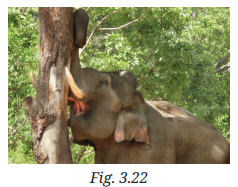
(i) Immediate Impact:
The bark of a tree consists of cork cells (which are dead cells) that create the outermost protective layer. Once the bark is stripped away, the tree forfeits its primary layer of defense. The tree is subject to mechanical harm, assaults from pathogens and parasites, excessive moisture loss from the trunk, and harm from severe temperatures. The protective role of the dermal tissue system is entirely diminished.
(ii) Tissues Involved & Affected:
The lateral meristem (cork cambium) and phloem are positioned just below the bark. If the trunk sustains more damage, the phloem tissue will be impacted. Phloem transports nutrients from the leaves to the roots and various other sections of the plant. Injury to the phloem would halt the food supply, causing the roots and lower sections of the plant to starve and ultimately perish.
(iii) Long-term Effect on Growth:
If the tissues under the bark (primarily phloem and the lateral meristem) are harmed, the movement of nutrients from the leaves to the other parts of the plant would cease. The lateral meristem would be harmed, indicating the tree could no longer increase in diameter. Eventually, the tree would become weaker, cease growth, and might die as the roots would be deprived of their nutrients.
(iv) Key Assumptions:
We are presuming that the debarking is finished completely around the trunk (referred to as ring barking) and that it penetrates sufficiently to harm the phloem. We are also presuming that the xylem remains undamaged. If only a section of the bark was removed (not entirely around the trunk), some phloem would still be present, allowing the tree to potentially survive. If the xylem sustains damage as well, water transport would cease, leading to a quicker death of the tree. The extent and seriousness of the damage would greatly alter the result.
Q8
Aamrapali observed that a young mango sapling’s stem bends flexibly during monsoon winds and does not break. Which tissue is responsible for this flexibility? Predict and provide your explanation of the impact if the existing tissue was replaced by sclerenchyma.
Tissue Responsible:
The tissue that provides flexibility to the young mango sapling is collenchyma. Collenchyma cells are living and possess irregularly thickened cell walls at the corners. This provides mechanical support along with flexibility, allowing stems and leaves to bend without breaking in strong winds.
Impact of Replacement with Sclerenchyma:
Sclerenchyma cells are dead, thick-walled, and heavily lignified, providing rigid and unyielding mechanical support. If collenchyma were replaced by sclerenchyma, the young stem would become extremely hard, stiff, and brittle, losing its flexibility. As a result, the stem would likely snap or break under strong monsoon winds instead of bending safely.
Q9
Sohan designed an experiment for the regeneration of sugarcane, where he used cuttings to grow sugarcane. He used two types of cuttings, type ‘A’ and type ‘B’ (Fig. 3.23). After a few weeks, type ‘B’ cuttings sprouted and developed into sugarcane plants, whereas the type ‘A’ cuttings did not sprout.
(i) Why were the type ‘B’ cuttings able to grow as sugarcane but type ‘A’ could not?
(ii) What difference was present in type ‘B’ compared to type ‘A’?
(iii) What observation or measurement was made to determine whether this change had an effect?
(iv) What parameters should be kept the same for both types of cuttings to ensure a fair comparison?
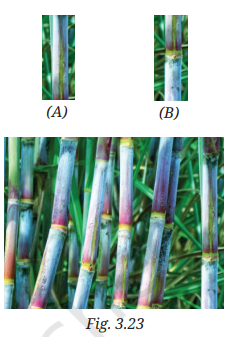
(i) Reason for growth in Type ‘B’:
Type ‘B’ cuttings were able to grow because they possessed nodes containing buds with active meristematic tissue, which can divide and differentiate into new roots and shoots. Type ‘A’ cuttings lacked nodes, so no new growth could occur.
(ii) Difference between Type ‘A’ and Type ‘B’:
Type ‘B’ cuttings included a node containing a bud, whereas Type ‘A’ cuttings consisted purely of internodal stem material without any nodes or buds.
(iii) Key Observation:
The observation made was whether the stem cuttings sprouted and developed into new sugarcane plants after a few weeks (Type ‘B’ sprouted, whereas Type ‘A’ did not).
(iv) Parameters to keep identical (Controlled Variables):
• Same soil type and soil moisture level
• Same amount and frequency of watering
• Same exposure to sunlight and ambient temperature
• Same length and thickness of the stem cuttings
Q10
During the discussion in class, Rohan gives a statement that, “A tissue is a group of similar cells performing similar functions”. But Rajiv counter argues that, “this is true in case of simple tissues but little different in case of complex tissues”. Provide your explanation in view of the discussion in class.
Explanation:
Both Rohan and Rajiv are correct in their contexts:
• Simple Tissues: As Rohan described, simple tissues (such as parenchyma, collenchyma, and sclerenchyma) are composed of a single type of cell that are structurally and functionally similar.
• Complex Tissues: As Rajiv pointed out, complex tissues (such as xylem and phloem) consist of more than one type of cell working together to perform a common function. For instance, xylem contains tracheids, vessels, xylem parenchyma, and xylem fibers.
Conclusion: A tissue is defined as a group of similar or dissimilar cells that work together to perform a specific function.
Q11
Coconut husk fibres are used for mats which are tough and fibrous. Which tissue has structural features suitable for providing this strength? Explain why living parenchyma couldn’t serve the same purpose.
Tissue Responsible:
The sclerenchyma tissue gives coconut husk fibers their toughness. Sclerenchyma cells are non-living (dead) at maturity, closely packed with no intercellular spaces, and have extremely thick walls due to uniform lignin deposition, making them highly resilient and fibrous.
Why Parenchyma is Unsuitable:
Living parenchyma cells have thin primary cell walls, loose packing with intercellular spaces, and active living cellular contents. They are soft, flexible, and adapted for storage or photosynthesis rather than mechanical support. If parenchyma were used, the fibers would lack tensile strength, be soft, and disintegrate rapidly under stress.
Q12
Vibha claims to her friend Neha that, “Meristematic cells are located only at the root and shoot apices”. What do you think about this statement? What question can Neha ask Vibha to help her understand further if the statement is incorrect?
Evaluation of Statement:
Vibha's statement is incorrect. While apical meristems are found at the tips (apices) of roots and shoots, meristematic tissues are also present in other regions of the plant, such as intercalary meristems (at nodes or base of leaves) and lateral meristems/cambium (responsible for increasing girth).
Question Neha Can Ask:
“If meristematic cells are present only at the tips of roots and shoots, how does a stem increase in thickness (girth) or regenerate leaves and branches from nodes?”
Q13
A plant cell and an animal cell are of the same size.
(i) Which cell will have a larger vacuole? Give reasons.
(ii) What assumptions are you making to answer the question above?
(i) Which cell will have a larger vacuole? Give reasons.
(ii) What assumptions are you making to answer the question above?
(i) Cell with Larger Vacuole:
The plant cell will have a significantly larger vacuole (often occupying 50%–90% of the total cell volume).
Reason: Plant cells require a large central vacuole to maintain turgidity, structural rigidity, and to store water, nutrients, and waste products. Animal cells typically have small, temporary vacuoles or none at all.
(ii) Assumptions Made:
• The plant cell is a fully mature/adult cell (as young plant cells have smaller vacuoles).
• Both cells are healthy and operating under normal physiological conditions.
• The comparison is made between typical plant and animal cell types.
Q14
A textbook states, “Each plant tissue performs only one specific function”. What questions would you ask to critically examine the correctness of this statement? What examples of tissues would you take to find out the answers to these questions?
Critical Questions to Ask:
1. Do all plant tissues perform strictly a single role, or can individual tissues perform multiple distinct functions?
2. Can a simple tissue simultaneously provide structural support, store nutrients, or perform photosynthesis?
3. Do complex tissues contain different cell types that carry out distinct individual sub-tasks to achieve a common function?
Examples to Test the Statement:
• Parenchyma: Acts as storage tissue, carries out photosynthesis (chlorenchyma), and provides buoyancy in aquatic plants (aerenchyma).
• Collenchyma: Provides mechanical support and flexibility while retaining the ability to photosynthesize if chloroplasts are present.
• Xylem: Transports water/minerals and simultaneously provides structural and mechanical support to the plant body.
Q15
A textbook states, “Each plant tissue performs only one specific function”. What questions would you ask to critically examine the correctness of this statement? What examples of tissues would you take to find out the answers to these questions?
Critical Questions to Ask:
1. Do all plant tissues perform strictly a single role, or can individual tissues perform multiple distinct functions?
2. Can a simple tissue simultaneously provide structural support, store nutrients, or perform photosynthesis?
3. Do complex tissues contain different cell types that carry out distinct individual sub-tasks to achieve a common function?
Examples to Test the Statement:
• Parenchyma: Acts as storage tissue, carries out photosynthesis (chlorenchyma), and provides buoyancy in aquatic plants (aerenchyma).
• Collenchyma: Provides mechanical support and flexibility while retaining the ability to photosynthesize if chloroplasts are present.
• Xylem: Transports water/minerals and simultaneously provides structural and mechanical support to the plant body.
1. Do all plant tissues perform strictly a single role, or can individual tissues perform multiple distinct functions?
2. Can a simple tissue simultaneously provide structural support, store nutrients, or perform photosynthesis?
3. Do complex tissues contain different cell types that carry out distinct individual sub-tasks to achieve a common function?
Examples to Test the Statement:
• Parenchyma: Acts as storage tissue, carries out photosynthesis (chlorenchyma), and provides buoyancy in aquatic plants (aerenchyma).
• Collenchyma: Provides mechanical support and flexibility while retaining the ability to photosynthesize if chloroplasts are present.
• Xylem: Transports water/minerals and simultaneously provides structural and mechanical support to the plant body.