Chapter 4: Describing Motion Around Us
Verified step-by-step solutions for your class notes.
Q1
My father went to a shop from home which is located at a distance of 250 m on a straight road. On reaching there, he discovered that he forgot to carry a cloth bag. He came home to take it, went to the shop again, bought provisions and came back home. How much was the total distance travelled by him? What was his displacement from home?
Let us follow the path one step at a time.
Trip 1: Residence to Store = 250 m
Travel 2: Store to Residence = 250 m
Trip 3: House to Store = 250 m
Trip 4: Store to Residence = 250 m
Overall distance covered = 250 + 250 + 250 + 250 = 1000 m
Displacement = ending position – starting position
His father began at home and finished at home.
Thus, his starting point and ending point are identical.
Displacement is 0 m.
Q2
A student runs from the ground floor to the fourth floor of a school
building to collect a book and then comes down to their classroom on
the second floor. If the height of each floor is 3 m, find:
(i) the total vertical distance travelled, and
(ii) their displacement from the starting point.
(i) the total vertical distance travelled, and
(ii) their displacement from the starting point.
Height per floor: 3 m.
First floor from the Ground Floor up to the fourth level.
The student climbs 4 floors.
The equation Distance Up = 4 3 is equivalent to 12 m.
The second phase involves moving from the 4th to the 2nd floor.
Students move down two floors, from 4 to 2.
The equation "Distance Up 2 3 = 6 m" is accurate.
The total vertical distance is 12 + 6 = 18 m.
(ii) Displacement:
The student's ultimate accommodation is on the 2nd floor, which is situated above the ground floor.
The displacement (upwards) is 2 floors, and when less than 3 meters is equal to 6 meters.
Q3
A girl is riding her scooter and finds that its speedometer reading is
constant. Is it possible for her scooter to be accelerating and if so, how?
Yes, it is possible for the scooter to accelerate even if the speedometer reading is constant.This happens because velocity is a vector quantity, meaning it has both magnitude (speed) and direction. Acceleration is defined as the rate of change of velocity. If either the speed or the direction changes, acceleration occurs.If the girl rides her scooter at a constant speed along a curved path or a circular track, her direction of motion changes continuously at every point. Since her direction is changing, her velocity is changing, which means the scooter is accelerating (known as centripetal acceleration).
Q4
A car starts from rest and its velocity reaches 24 m s–1 in 6 s. Find the
average acceleration and the distance travelled in these 6 s.
1. Given Information:
• Initial Velocity (u) = 0 m/s (starts from rest)
• Final Velocity (v) = 24 m/s
• Time (t) = 6 s
2. Calculating Average Acceleration (a):
• Formula: a = (v - u) / t
• a = (24 - 0) / 6
• a = 24 / 6 = 4 m/s²
∴ Average acceleration = 4 m/s²
3. Calculating Distance Travelled (s):
• Formula: s = ut + (1/2)at²
• s = (0 × 6) + (1/2 × 4 × 6²)
• s = 0 + (2 × 36) = 72 m
∴ Distance travelled = 72 m
Q5
A motorbike moving with initial velocity 28 m s–1 and constant
acceleration stops after travelling 98 m. Find the acceleration of the
motorbike and the time taken to come to a stop.
1. Given Information:
• Initial Velocity (u) = 28 m/s
• Final Velocity (v) = 0 m/s (Motorbike stops)
• Distance (s) = 98 m
2. Finding the Acceleration (a):
• Formula: v² = u² + 2as
• 0² = (28)² + 2 × a × 98
• 0 = 784 + 196a
• -196a = 784
• a = 784 / -196 = -4 m/s²
*Note: The negative sign indicates deceleration (retardation) because the bike is slowing down.
3. Finding the Time Taken (t):
• Formula: v = u + at
• 0 = 28 + (-4) × t
• 4t = 28
• t = 28 / 4 = 7 seconds
∴ The retardation of the motorbike is 4 m/s² and it takes 7 seconds to stop.
Q6
Fig. 4.27 shows a position-time graph of two objects A and B that are
moving along the parallel tracks in the same direction. Do objects
A and B ever have equal velocity? Justify your answer.
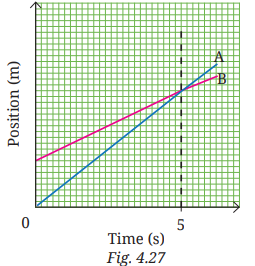
Answer: No, objects A and B never have equal velocity.
Explanation:
• On a position-time graph, the slope (gradient) represents the velocity of the object.
• Object A: The graph is a straight line with a steeper slope, showing it moves at a higher constant velocity.
• Object B: The graph is a straight line with a gentler slope, showing it moves at a lower constant velocity.
Since both lines are straight with different slopes, both objects maintain different, constant velocities at all times.
Note on Intersection: Although the two lines intersect , this intersection indicates they share the same position at that instant, not the same velocity. Velocity depends strictly on the slope of the line.
Q7
A graph in Fig. 4.28 shows the change in position with time for two
objects A and B moving in a straight line from 0 to 10 seconds. Choose
the correct option(s).
(i) The average velocity of both over the 10 s time interval is equal
since they have the same initial and final positions.
(ii) The average speeds of both over the 10 s time interval are equal
since both cover equal distance in equal time.
(iii) The average speed of A over the 10 s time interval is lower than
that of B since it covers a shorter distance than B in 10 seconds.
(iv) The average speed of A over the 10 s time interval is greater than
that of B since B’s speed is lower than A’s in some segments.
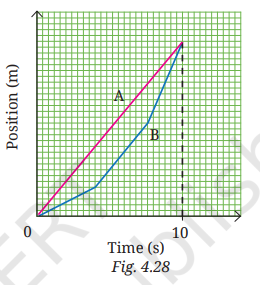
Correct Options: (i) and (ii)
Why?
(i) Statement (i) is correct: Both objects start and end at the exact same positions over the given time interval. Since average velocity depends solely on total displacement divided by total time, their average velocities are equal.
(ii) Statement (ii) is correct: Because both objects cover the same displacement in the same amount of time, their overall average speeds are identical.
(iii) Statement (iii) is incorrect: Object A does not cover less distance than Object B; both objects cover the exact same net distance to arrive at the same final position.
(iv) Statement (iv) is incorrect: Average speed is determined by total path length divided by total time, not by individual instantaneous motion segments.
Q8
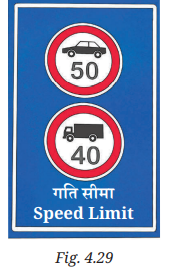
A truck driver driving at the speed of 54 km/h notices a road sign
with a speed limit of 40 km/h (Fig. 4.29) for trucks. He slows down
to 36 km/h in 36 s. What was the distance travelled by him during this
time? Assume the acceleration to be constant while slowing down
1. Formula:
Since acceleration is uniform, distance (s) is given by the average velocity formula:
s = ((u + v) / 2) × t
2. Unit Conversion:
• u = 54 km/h = 54 × (5/18) = 15 m/s
• v = 36 km/h = 36 × (5/18) = 10 m/s
• t = 36 s
3. Calculation:
s = ((15 + 10) / 2) × 36
s = (25 / 2) × 36
s = 12.5 × 36 = 450 m
Answer: The distance covered is 450 m.
Q9
A car starts from rest and accelerates uniformly to 20 m/s in
5 seconds. It then travels at 20 m/s for 10 seconds and finally
applies the brake (with uniform acceleration) to stop in 6 seconds.
Find the total distance travelled.
Phase 1: Acceleration (0 to 20 m/s in 5 s)
Given: u = 0 m/s, v = 20 m/s
S1 = ((0 + 20) / 2) × 5 = 10 × 5 = 50 m
Phase 2: Constant Speed (20 m/s for 10 s)
S2 = 20 × 10 = 200 m
Phase 3: Deceleration (20 m/s to 0 in 6 s)
S3 = ((20 + 0) / 2) × 6 = 10 × 6 = 60 m
Total Distance:
S = 50 + 200 + 60 = 310 m
Given: u = 0 m/s, v = 20 m/s
S1 = ((0 + 20) / 2) × 5 = 10 × 5 = 50 m
Phase 2: Constant Speed (20 m/s for 10 s)
S2 = 20 × 10 = 200 m
Phase 3: Deceleration (20 m/s to 0 in 6 s)
S3 = ((20 + 0) / 2) × 6 = 10 × 6 = 60 m
Total Distance:
S = 50 + 200 + 60 = 310 m
Q10
A bus is travelling at 36 km/h when the driver sees an obstacle
30 m ahead. The driver takes 0.5 seconds to react before pressing the
brake. Once the brake is applied, the velocity of the bus reduces with
constant acceleration of 2.5 m/s². Will the bus be able to stop before
reaching the obstacle?
Unit Conversion:
36 km/h = 36 × (5/18) = 10 m/s
Step 1: Distance covered during reaction time
Reaction Distance (s1) = u × t = 10 m/s × 0.5 s = 5 m
Step 2: Braking Distance
Given: u = 10 m/s, v = 0 m/s, a = -2.5 m/s2
Using v2 = u2 + 2as2:
02 = 102 + 2(-2.5)s2
0 = 100 - 5s2
5s2 = 100 ⇒ s2 = 20 m
Total Stopping Distance:
s = s1 + s2 = 5 m + 20 m = 25 m
Conclusion:
Since 25 m < 30 m, yes, the bus stops safely.
Q11
A student said, “The Earth moves around the Sun”. In this context,
discuss whether an object kept on the Earth can be considered to be
at rest.
Concept:
Rest and motion are relative terms that depend entirely on the observer's frame of reference.
Explanation:
• Earth's Frame of Reference: An object placed in a room or on the ground appears to be at rest with respect to the Earth's surface.
• Sun's/Space Frame of Reference: The same object is in continuous motion when viewed from space or relative to the Sun, as it moves along with the Earth during its rotation and orbital revolution.
Q12
The velocity-time graph from 0 s to 120 s for a cyclist is shown in Fig. 4.30.
Shade the areas (in different colours) representing the displacement of
the cyclist
(i) while cyclist is moving with constant velocity.
(ii) when the velocity of cyclist is decreasing.
Also, calculate the displacement and average acceleration in the 120 s
time interval.
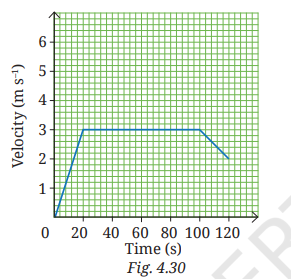
1. Graph Shading Instructions:
• Constant Velocity Region: Shade the rectangular area under the graph between t = 20 s and t = 100 s.
• Decreasing Velocity Region: Shade the trapezoidal area under the graph between t = 100 s and t = 120 s.
2. Displacement Calculation (Total Area Under Graph):
• Area 1 (Triangle, 0 – 20 s): (1/2) × 20 × 3 = 30 m
• Area 2 (Rectangle, 20 – 100 s): 80 × 3 = 240 m
• Area 3 (Trapezium, 100 – 120 s): (1/2) × (3 + 2) × 20 = 50 m
Total Displacement:
s = 30 + 240 + 50 = 320 m
3. Average Acceleration:
Average Acceleration = [ (Final Velocity − Initial Velocity) / Total Time ]
a = (2 − 0) / 120 = 1/60 m/s2
Q13
A girl is preparing for her first marathon by running on a straight
road. She uses a smartwatch to calculate her running speed at
different intervals. The graph (Fig. 4.31) depicts her velocity versus
time. Estimate the distance she ran based on the graph.
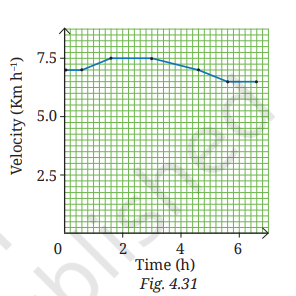
Estimation Strategy:
To estimate the total distance, we calculate the area under the velocity-time curve (Fig. 4.31) across four distinct phases:
1. Phase 1 (0 – 1.5 h):
• Approximate average velocity = 7.1 km/h
• Distance1 ≈ 7.1 × 1.5 = 10.65 km
2. Phase 2 (1.5 – 3 h):
• Constant velocity = 7.5 km/h
• Distance2 = 7.5 × 1.5 = 11.25 km
3. Phase 3 (3 – 5.5 h):
• Velocity drops linearly from 7.5 to 6.5 km/h (Average ≈ 7.0 km/h)
• Distance3 = 7.0 × 2.5 = 17.5 km
4. Phase 4 (5.5 – 7 h):
• Constant velocity = 6.5 km/h
• Distance4 ≈ 6.5 × 1.5 = 9.75 km
Total Estimated Distance:
Total Distance ≈ 10.65 + 11.25 + 17.5 + 9.75 = 49.15 km
Q14
: A body moves with a uniform velocity of 6 m/s for 2 minutes. It then accelerates uniformly at 1 m/s² for 14 seconds. Calculate the displacement in both phases and total displacement.
Phase 1: s1 = 6 × 120 = 720 m
Phase 2: s2 = 6(14) + 0.5(1)(14)² = 182 m
Total Displacement: 902 m
Phase 2: s2 = 6(14) + 0.5(1)(14)² = 182 m
Total Displacement: 902 m
Q15
: A body moves with a uniform velocity of 6 m/s for 2 minutes. It then accelerates uniformly at 1 m/s² for 15 seconds. Calculate the displacement in both phases and total displacement.
Phase 1: s1 = 6 × 120 = 720 m
Phase 2: s2 = 6(15) + 0.5(1)(15)² = 202.5 m
Total Displacement: 922.5 m
Phase 2: s2 = 6(15) + 0.5(1)(15)² = 202.5 m
Total Displacement: 922.5 m
Q16
A body moves with a uniform velocity of 6 m/s for 2 minutes. It then accelerates uniformly at 1 m/s² for 16 seconds. Calculate the displacement in both phases and total displacement.
Phase 1: s1 = 6 × 120 = 720 m
Phase 2: s2 = 6(16) + 0.5(1)(16)² = 224 m
Total Displacement: 944 m
Phase 2: s2 = 6(16) + 0.5(1)(16)² = 224 m
Total Displacement: 944 m