Chapter 5: Exploring Mixtures and Their Separation
Verified step-by-step solutions for your class notes.
Q1
Which of the following mixtures are correctly classified as
homogeneous (Hm) and heterogeneous (Ht)? Choose the correct
option.
(i) Air — Hm, Milk — Ht, Sugar solution — Hm, Smoke — Hm
(ii) Brass — Ht, Fog — Ht, Vinegar — Ht, Muddy water — Hm
(iii) Copper sulfate solution — Hm, Salt solution — Hm, Milk — Hm, Bronze — Hm
(iv) Muddy water — Ht, Milk — Ht, Blood — Ht, Brass — Hm
(i) Air — Hm, Milk — Ht, Sugar solution — Hm, Smoke — Hm
(ii) Brass — Ht, Fog — Ht, Vinegar — Ht, Muddy water — Hm
(iii) Copper sulfate solution — Hm, Salt solution — Hm, Milk — Hm, Bronze — Hm
(iv) Muddy water — Ht, Milk — Ht, Blood — Ht, Brass — Hm
(iv) Muddy water — Ht, Milk — Ht, Blood — Ht, Brass — Hm is the answer to the MCQ
Q2
Choose the correct options, and explain the reason for the correct and
incorrect options.
Which among the following mixtures show the Tyndall Effect? A mixture of:
(a) air and dust particles
(b) copper sulfate and water
(c) starch and water
(d) acetone and water
Options -:
(i) a and b | (ii) b and d | (iii) a and c | (iv) c and d
Which among the following mixtures show the Tyndall Effect? A mixture of:
(a) air and dust particles
(b) copper sulfate and water
(c) starch and water
(d) acetone and water
Options -:
(i) a and b | (ii) b and d | (iii) a and c | (iv) c and d
The correct option is (iii) a and c.
Q3
A mixture can be categorised as a solution, a suspension, or a colloid,
each possessing distinct properties. Utilise the words or phrases
provided in the box to fill in the Table 5.2. Words and phrases may be
used more than once.
Words and Phrases
Large-sized particles; Particles remain evenly distributed; Small-sized particles (less than 1 nm diameter); Moderate-sized particles (1 – 1000 nm); Settles down when left undisturbed (more than 1000 nm in diameter); Does not settle down; Scatters light; Separates by filtration; Transparent; Salt solution; Milk; Sand in water; Smoke; Heterogeneous mixture; Cannot be separated by filtration; Mud; Butter; Brass.
The table is provided in the image aswell as the answer.
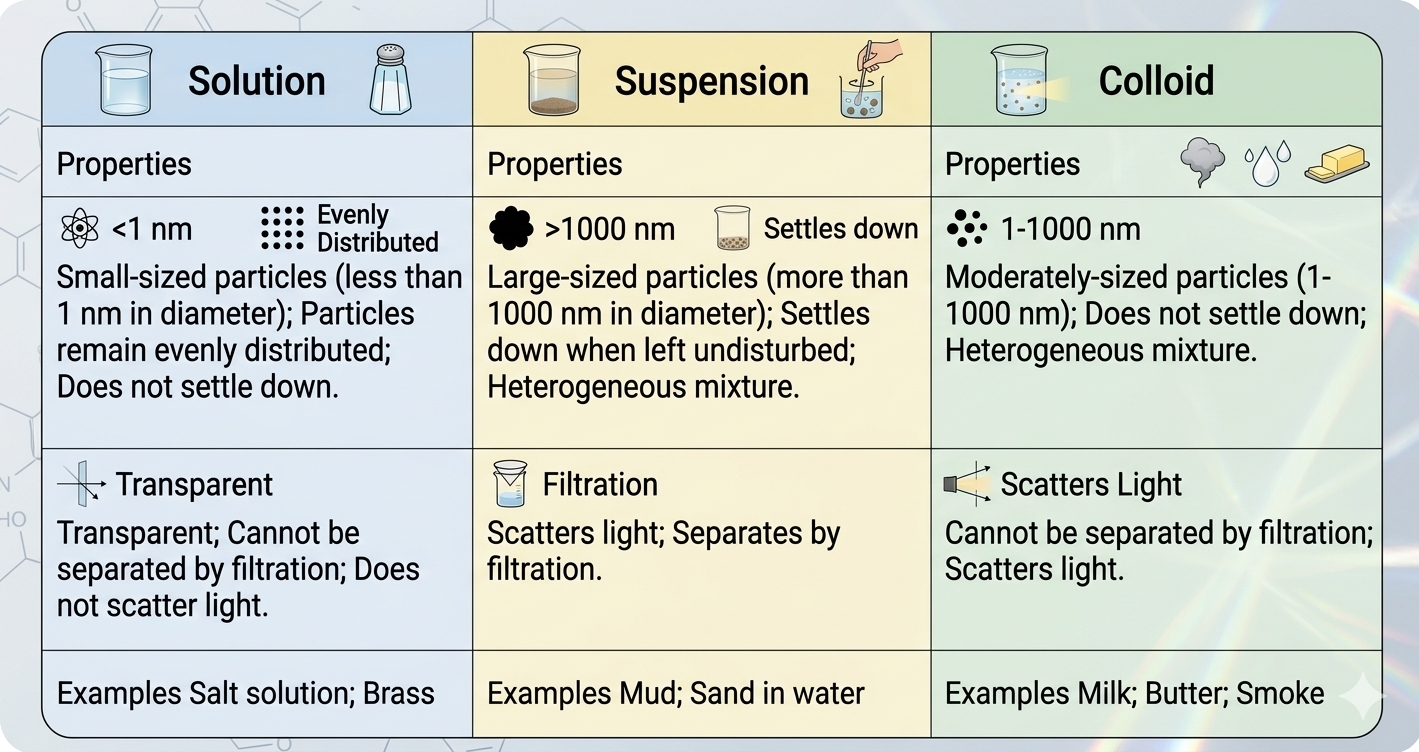
Answer gave in the image, thanks.
Q4
Solve the following problems:
(i) A cake recipe uses dry ingredients, namely 75 g of sugar for 420 g of all-purpose flour and 5 g of sodium hydrogencarbonate. Express the concentration of each component in the mixture using an appropriate method.
(ii) A brass alloy contains 70% copper by mass. Calculate the quantities of copper and zinc present in 120 g of brass.
(i): First, Total weight of dried mix: 75g (Sugar), + 420g (All in one purpose flour) + 5g Sodium Hydrogencarbonate (Simply you can write baking soda!)
Percentage share of each item,
- Sugar: (75/100) x 100 = 15%
- Flour: (420/500) x 100 = 84%
- Baking Soda (Sodium hydrogencarbonate): (5/500) x 100 = 1%
(ii) We know Brass is 70% Copper and The rest Is Zinc (30%)
For a 120g block of brass:
- Copper: 70% of 120g = (70/120) x 100 = 84g
- Zinc: Simply, it is the remaining weight left so it would be 120g - 84g = 36g
Q5
The label on a cooking oil pack says one litre (910 g). If this oil is mixed
with water, will it form a separate layer? If so, which substance will be
on top? How will you separate the two layers? Also, draw the diagram
of the apparatus used.
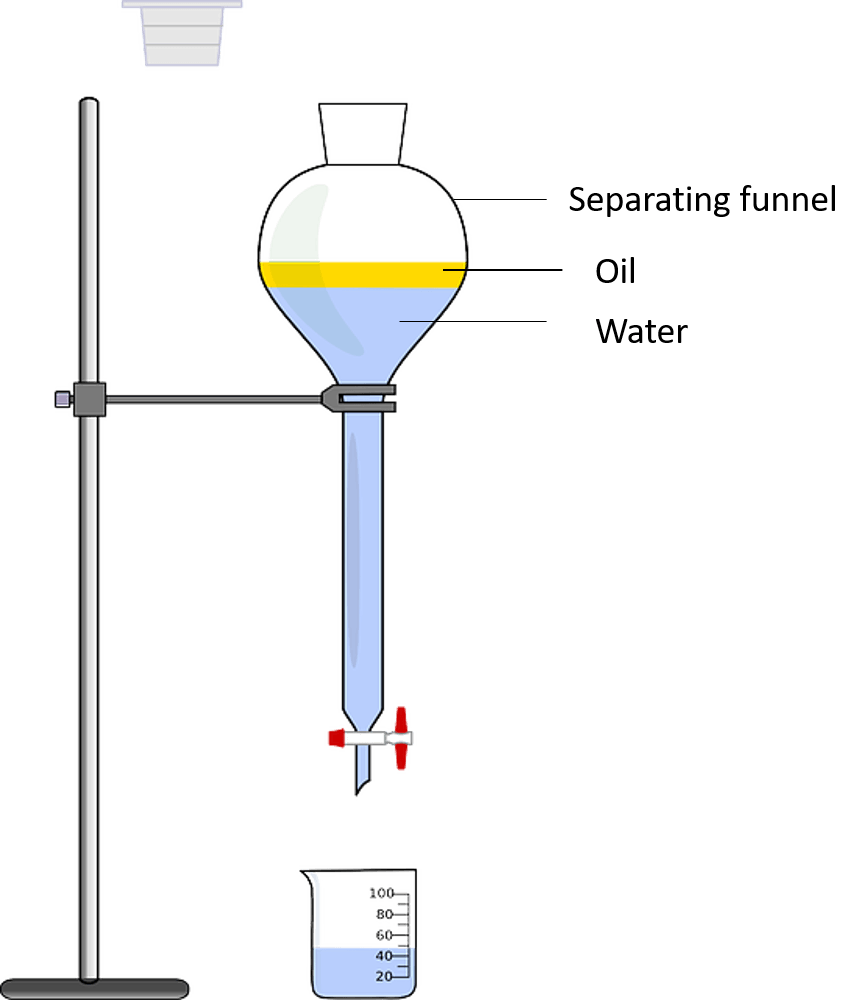
The oil will form a seperate layer, which forms above the water because it has lesser density that the water. The two layers can be seperated with the seperating funnel method. The diagram is given above
Q6
Assertion (A): Solutions do not exhibit the Tyndall effect.
Reason (R): The particles in solutions are larger than 100 nm, so they cannot scatter light.
Choose the correct option:
(i) Both A and R are true, and R is the correct explanation of A
(ii) Both A and R are true, but R is not the correct explanation of A
(iii) A is true, but R is false.
Reason (R): The particles in solutions are larger than 100 nm, so they cannot scatter light.
Choose the correct option:
(i) Both A and R are true, and R is the correct explanation of A
(ii) Both A and R are true, but R is not the correct explanation of A
(iii) A is true, but R is false.
Type solutions here.
(iv) A is false, but R is true.
(iv) A is false, but R is true.
Q7
How would you separate the mixtures given in Table 5.3? Mention the
reason for choosing your method. If a mixture cannot be separated,
explain why.
| Mixture | Method of separation | Reason for selection |
|---|---|---|
| Mud from muddy water | Coagulation + Filtration | Adding alum makes tiny dirt particles clump together so they get heavy, sink, and easily get trapped by filter paper. |
| Plasma from other components in the blood sample | Centrifugation | Spinning blood ultra-fast forces heavy blood cells to slide to the bottom, leaving the clear, liquid plasma layer on top. |
| Naphthalene and sand | Sublimation | Naphthalene skips the melting phase and turns straight into a gas when heated, leaving the normal sand behind in the dish. |
| Chalk powder and common salt | Dissolution → Filtration → Evaporation | Salt dissolves in water but chalk won't. You can filter out the chalk pieces, then boil the water away to get dry salt back. |
| Common salt and water | Evaporation (or Distillation) | Boiling evaporates the water away to leave solid salt. If you actually want to collect and keep the pure water too, use distillation. |
| Oil from water | Separating Funnel | They don't mix at all and split into two separate layers based on weight, letting you easily drain the water out from the bottom. |
| Pigments of the flower | Paper Chromatography | Different color dyes travel up filter paper at different speeds depending on how well they dissolve, making them split into distinct spots. |
Q8
Two miscible liquids, A and B, are present in a mixture. The boiling
point of A is 60 °C and the boiling point of B is 90 °C. Suggest a method
to separate them. Also, draw a labelled diagram of the method
suggested
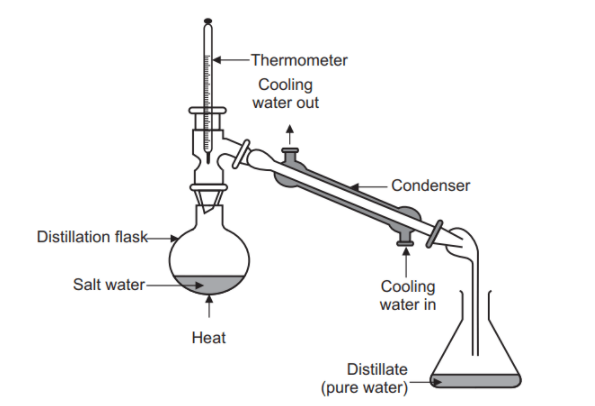
The method to seperate these 2 liquids is Simple distillation,
They mix perfect as they are miscible, but difference in their boiling points are >25 °C, A standard distillation setup give below will easily boil off Liquid A first without messing with Liquid B.
They mix perfect as they are miscible, but difference in their boiling points are >25 °C, A standard distillation setup give below will easily boil off Liquid A first without messing with Liquid B.
Q9
Compare evaporation, crystallization and distillation. In which
situation, would you prefer each of these over the others?
Evaporation is great when you only care about saving the solid solute and don't mid the solvent vapourise in the air.
Crystallisation is the best choice when you want a highly pure solid. It's way better than evaporation for sensitive things because you don't risk overheating, burning or ruining the solid. However, it is time taking.
Distillation is used when we need to save the liquid or seperate two liquids that are mixed together, since it catches the steam and condenses it back to the liquid form.
Q10
Blood is an example of a colloidal mixture
(i) What would happen if blood behaved like a true suspension inside the body?
(ii) In a blood sample, identify the dispersed phase and the dispersion medium.
(i) What would happen if blood behaved like a true suspension inside the body?
(ii) In a blood sample, identify the dispersed phase and the dispersion medium.
(i) If blood acted like a true suspension, the heavy blood cells would settle out and pool at the bottom of your veins every time you sat still or went to sleep. This would immediately block your blood flow and stop oxygen from reaching your organs.
(ii) The dispersed phase consists of the blood cells (red cells, white cells, and platelets), while the dispersion medium is the liquid plasma they float in.
(ii) The dispersed phase consists of the blood cells (red cells, white cells, and platelets), while the dispersion medium is the liquid plasma they float in.
Q11
You are given a mixture of sand, common salt and naphthalene
(Fig. 5.25a). The Fig. 5.25b depicts various steps used to separate the
components of this mixture. Identify and write down the correct
sequence of separation techniques.
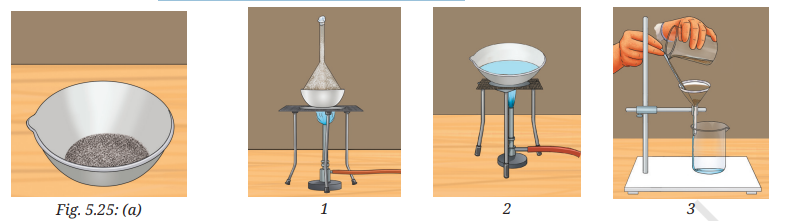
The correct order would be 3 --> 1 --> 2
Start with Setup 3 (Sublimation) to heat the mix so the naphthalene vaporises and separates out. Next, take whatever is left (sand and salt), mix it with water so the salt dissolves, and use Setup 1 (Filtration) to catch the sand. Finally, take that clear salty liquid and use Setup 2 (Evaporation) to boil away the water, leaving you with dry salt.
Start with Setup 3 (Sublimation) to heat the mix so the naphthalene vaporises and separates out. Next, take whatever is left (sand and salt), mix it with water so the salt dissolves, and use Setup 1 (Filtration) to catch the sand. Finally, take that clear salty liquid and use Setup 2 (Evaporation) to boil away the water, leaving you with dry salt.
Q12
Why is distillation an effective method for separating a mixture of
water and acetone?
It works perfectly because water and acetone boil at completely different temperatures. Acetone has a really low boiling point of 56°C, while water needs to hit 100°C to boil. This massive temperature gap means all the acetone turns to vapor and moves over to the cooling flask long before the water even gets hot enough to start evaporating.
Q13
Answer the following questions with the help of the data given in
Table 5.4
(i)What mass of potassium nitrate would be needed to prepare its saturated solution in 50 g of water at 40 °C?
(ii) A student makes a saturated solution of potassium chloride in water at 80 °C and leaves the solution to cool at room temperature (25 °C). What would she observe as the solution cools? Explain.
(iii) What is the effect of a change in temperature on the solubility of salts? Also, compare the changes in the solubility of the four given salts with increasing temperature from 10 °C to 80 °C.
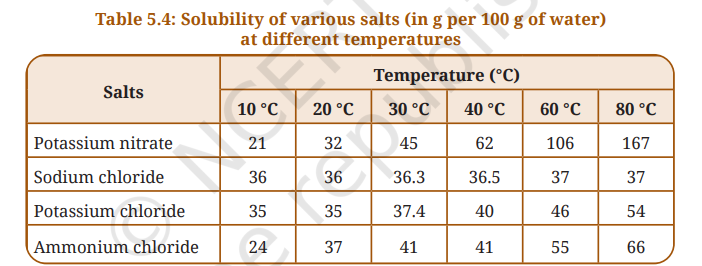
(i) The chart says 100 g of water needs 62 g of potassium nitrate to max out at 40°C. Since we are using exactly half the water (50 g), we only need half the salt: 31 g.
(ii) She will see solid crystals of potassium chloride starting to appear and settle at the bottom. This happens because hot water can hold a lot of salt (54g at 80°C), but as it cools down to room temperature, its capacity drops significantly, forcing the extra dissolved salt to precipitate out.
(iii)For most salts, getting the water hotter means you can dissolve way more salt. Looking at the data: Potassium nitrate goes through a massive jump (surging from 21g to 167g). Ammonium chloride and Potassium chloride rise steadily. Sodium chloride barely cares about the heat—its solubility stays almost completely flat around 36g–37g.
Q14
Three students, A, B and C, are preparing sugar solutions for an
experiment:
- Student A dissolves 20 g of sugar in 80 g of water.
- Student B dissolves 20 g of sugar in 100 g of water.
- Student C dissolves 30 g of sugar in 80 g of water.
(i) Calculate the mass percentage (% m/m) concentration of sugar in each student’s solution.
(ii) Whose solution is the most concentrated? Explain why.
Student A: 20 g sugar / 100 g total weight × 100 = 20%
Student B: 20 g sugar / 120 g total weight × 100 = 16.67%
Student C: 30 g sugar / 110 g total weight × 100 = 27.27%
(ii) Student C made the strongest (most concentrated) solution. Their mix has the highest percentage of sugar relative to the total weight of the liquid.
Student B: 20 g sugar / 120 g total weight × 100 = 16.67%
Student C: 30 g sugar / 110 g total weight × 100 = 27.27%
(ii) Student C made the strongest (most concentrated) solution. Their mix has the highest percentage of sugar relative to the total weight of the liquid.
Q15
Examine Fig. 5.26.
(i) Identify the separation technique marked as ‘S’
(ii) Label the apparatus A, B and C.
(iii) Which of the following mixtures can be separated by the technique identified above? Use the data given in Table 5.5. Mixtures:
(a) water — acetone (b) water — salt
(c) acetone — alcohol (d) sand — salt
(e) alcohol — chloroform (f) alcohol — benzene
| Solvent | Water | Acetone | Alcohol | Chloroform | Benzene |
| Temperature (°C) | 100 °C | 56 °C | 78 °C | 61 °C | 80 °C |
Which of the mixtures can be separated by Simple Distillation?
Out of the options provided in the question, the mixtures that can be separated using this setup are:
- (a) water – acetone: This works perfectly because water boils at 100°C and acetone at 56°C. Their boiling point difference is 44°C, which easily clears the minimum 25°C gap needed for simple distillation.
- (b) water – salt: This is a standard liquid-solid solution where only the water vaporises, leaving the non-volatile solid salt completely behind in the flask.
Note: Mixtures like (c) acetone-alcohol, (e) alcohol-chloroform, and (f) alcohol-benzene have boiling points that are too close together (less than a 25°C difference), so they would require fractional distillation instead.