Chapter 9: Atomic Foundations of Matter
Verified step-by-step solutions for your class notes.
A particular element (A) has one electron in its third shell. There is another element (B) with six electrons in its second shell.
(i) How many electrons does A tend to give or take to become stable?
(ii) What kind of ion would it form?
(iii) How many electrons does B tend to give or take to become stable?
(iv) What kind of ion would it form?
(v) If A and B were to combine, what kind of bond would be formed?
(vi) What would be the formula for the compound thus formed?
- (i) Atomic Number / Electrons: Element A has configuration 2, 8, 1, so it tends to give 1 electron to become stable.
- (ii) Type of Ion: By losing 1 negative electron, it forms a positive ion, which is a cation (A+).
- (iii) Electrons for B: Element B has configuration 2, 6, so it tends to take 2 electrons to complete its outer shell octet.
- (iv) Type of Ion for B: By gaining 2 negative electrons, it forms a negative ion, which is an anion (B2−).
- (v) Type of Bond: A complete transfer of electrons from a metal-like element (A) to a non-metal element (B) results in an ionic bond.
- (vi) Chemical Formula: Exchanging and criss-crossing their valencies (A1+ and B2−) yields the formula A2B.
An element X has six electrons in its outer shell and forms a diatomic molecule.
(i) Why would that be so?
(ii) What kind of bond would it form?
(iii) Draw the structure of the molecule it would form.
(iv) A certain other element Y has two electrons in its second shell. Draw the structure of the molecule that X would form with Y.
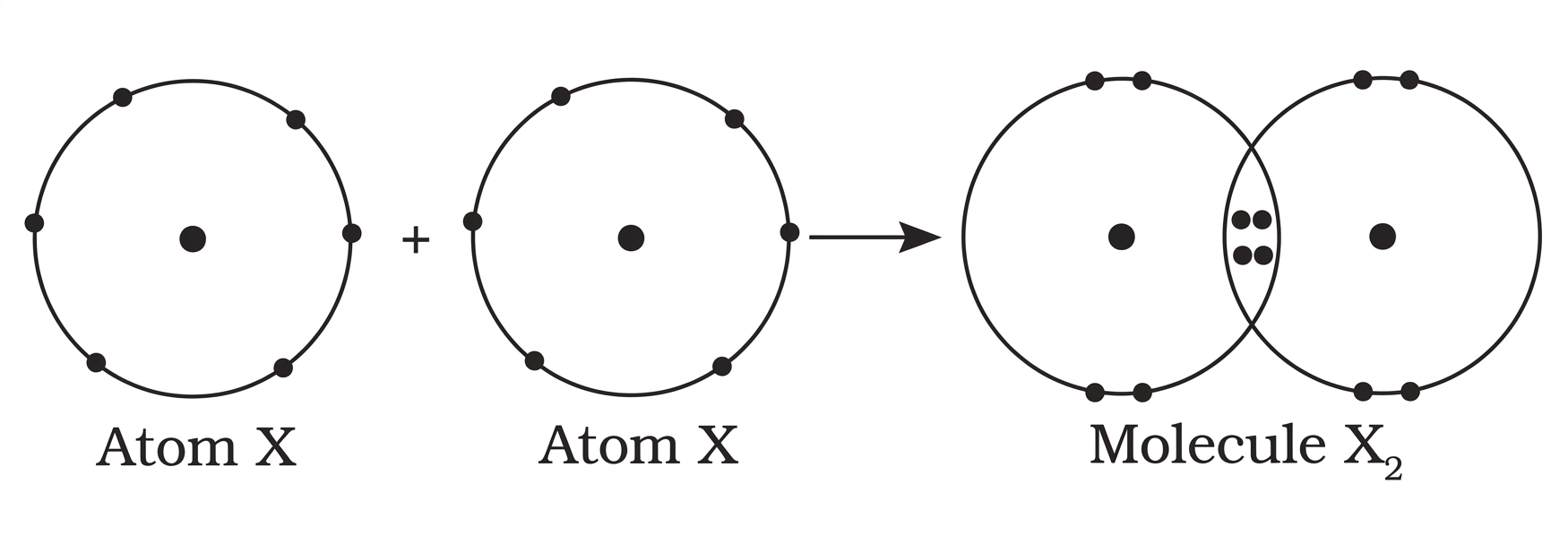
- (i) Reason for Diatomic Molecule: Element X requires 2 more valence electrons to achieve a stable octet structure. By sharing 2 electrons with another identical X atom, both achieve stability.
- (ii) Type of Bond: Because two pairs of valence electrons are shared between the interacting atoms, it forms a double covalent bond.
- (iii) Structure of X2 Molecule: It is structurally represented by sharing two electron pairs, written as X = X or :X::X:.
- (iv) Structure of YX Molecule: Element Y (configuration 2, 2) transfers its 2 valence electrons entirely to X (configuration 2, 6), creating an ionic layout written as [Y]2+[:X:]2− or formula unit YX.
You want to design a new ionic compound, where the total positive charge is 6+ and the total negative charge is 6−. Which of the following combinations gives the correct number of ions?
(i) 2 Al3+ and 3 Cl−
(ii) 3 Mg2+ and 1 PO43−
(iii) 2 Fe3+ and 3 O2−
(iv) 3 Ca2+ and 2 SO42−
- Correct Option: (iii) 2 Fe3+ and 3 O2−. The total positive charge is 2 × (+3) = +6, and the total negative charge is 3 × (−2) = −6, which matches perfectly.
Choose the correct statement(s) and correct the false statement(s).
(i) Elements are made up of molecules and compounds are made up of atoms.
(ii) The molecule of a compound is always made up of two or more atoms of the same kind.
(iii) One molecule of nitrogen gas contains three nitrogen atoms.
(iv) Water is made of two hydrogen atoms, covalently bonded with one oxygen atom.
- (i) False: Elements are made up of atoms (or molecules of the same atom), while compounds are made up of different atoms combined.
- (ii) False: The molecule of a compound is always composed of two or more atoms of different kinds chemically bonded together.
- (iii) False: One molecule of stable nitrogen gas (N2) contains exactly two nitrogen atoms held by a triple bond.
- (iv) True: Water (H2O) consists exactly of two individual hydrogen atoms sharing their single valence electron pairs covalently with one oxygen atom.
Write the chemical formulae for the following compounds.
(i) Aluminium nitrate
(ii) Calcium oxide
(iii) Ferric oxide
- (i) Aluminium nitrate: Al(NO3)3
- (ii) Calcium oxide: CaO
- (iii) Ferric oxide: Fe2O3
Write the formulae of the compounds formed from the following pairs of ions.
(i) Ca2+ and Br−
(ii) Al3+ and CO32−
(iii) K+ and SO42−
(iv) NH4+ and Cl−
- (i) Ca2+ and Br−: CaBr2
- (ii) Al3+ and CO32−: Al2(CO3)3
- (iii) K+ and SO42−: K2SO4
- (iv) NH4+ and Cl−: NH4Cl
Which of the following, in Fig. 9.18, correctly represents Cl− ion (Atomic number of chlorine = 17).
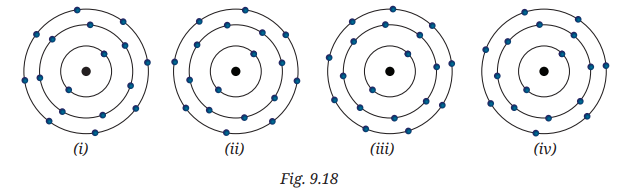
- Correct Representation: The option showing an electron shell arrangement of 2, 8, 8. A neutral chlorine atom has 17 electrons (2, 8, 7), so gaining 1 electron to become a Cl− ion fills the valence shell to 8 electrons.
Determine the formula unit mass of the following substances.
(i) Ammonium nitrate (NH4NO3)
(ii) Phosphoric acid (H3PO4)
(iii) Sodium hydrogencarbonate (NaHCO3)
- (i) Ammonium nitrate (NH4NO3): 80 u ⟶ (14 × 2) + (1 × 4) + (16 × 3) = 28 + 4 + 48.
- (ii) Phosphoric acid (H3PO4): 98 u ⟶ (1 × 3) + 31 + (16 × 4) = 3 + 31 + 64.
- (iii) Sodium hydrogencarbonate (NaHCO3): 84 u ⟶ 23 + 1 + 12 + (16 × 3) = 23 + 1 + 12 + 48.
Write the formulae for the compounds formed by the reaction of:
(i) Magnesium and nitrogen
(ii) Lithium and nitrogen
(iii) Sodium and sulfur
(iv) Aluminium and oxygen
- (i) Magnesium and nitrogen: Mg3N2
- (ii) Lithium and nitrogen: Li3N
- (iii) Sodium and sulfur: Na2S
- (iv) Aluminium and oxygen: Al2O3
Complete the Table 9.3 by writing the formulae of the compounds formed by the cations on the left and the anions at the top.
| Cations / Anions | NO3− | SO42− | PO43− |
|---|---|---|---|
| NH4+ | NH4NO3 | (NH4)2SO4 | (NH4)3PO4 |
| Li+ | LiNO3 | Li2SO4 | Li3PO4 |
| Al3+ | Al(NO3)3 | Al2(SO4)3 | AlPO4 |
| Cu2+ | Cu(NO3)2 | CuSO4 | Cu3(PO4)2 |
5.3 g of sodium carbonate and 6.0 g of acetic acid react to produce 2.2 g of carbon dioxide, 0.9 g of water, and 8.2 g of sodium acetate. Verify whether the law of conservation of mass is valid.
- Mass of Reactants: 5.3 g (Sodium carbonate) + 6.0 g (Acetic acid) = 11.3 g
- Mass of Products: 2.2 g (Carbon dioxide) + 0.9 g (Water) + 8.2 g (Sodium acetate) = 11.3 g
- Verification Conclusion: Because the total initial mass of the combined reactants equals the final mass of the accumulated products, the Law of Conservation of Mass is valid.
If a species has 11 protons, 12 neutrons and 10 electrons then:
(i) what is its atomic number and mass number?
(ii) is it neutral, a cation or an anion? Explain.
(iii) write its electronic configuration.
(iv) name the species.
- (i) Atomic Number & Mass Number: Atomic Number = 11 (defined by protons). Mass Number = 11 protons + 12 neutrons = 23.
- (ii) Electrical State: It is a cation. It has 11 positive protons and only 10 negative electrons, leaving a net positive charge of +1.
- (iii) Electronic Configuration: 2, 8 (distributed across the K and L shells for 10 total electrons).
- (iv) Name of the Species: Sodium ion (Na+).
Two elements, A and B, have the following configurations —
A: 2, 8, 5
B: 2, 8, 7
(i) Which element is more reactive?
(ii) Will A and B form ionic or covalent bonds when they combine? Explain using electron transfer or sharing.
(iii) Predict the formula of the compound they would form.
- (i) Most Reactive Element: Element B is more reactive because it only needs to gain 1 single electron to complete its stable outer octet shell, whereas element A requires 3 electrons.
- (ii) Type of Bonding: They will form covalent bonds. Both A and B are non-metals requiring electrons to complete their octets; they will achieve stability by mutually sharing electron pairs instead of transferring them.
- (iii) Chemical Formula: Element A has a valency of 3, and element B has a valency of 1. Criss-crossing their respective valencies yields the formula AB3.
Assertion (A): Copper sulfate conducts electricity in the molten state but not in the solid state.
Reason (R): Copper and sulfate ions are fixed in the lattice in molten state, while in solid state they can move freely.
Choose the correct option:
(i) Both A and R are true, and R is the correct explanation of A.
(ii) Both A and R are true, but R is not the correct explanation of A.
(iii) A is true, but R is false.
(iv) A is false, but R is true.
- Correct Option: (iii) A is true, but R is false. The assertion is completely correct because ionic compounds conduct electricity only when ions are free to move. However, the reason statement is false because ions can move freely in the molten state, whereas they are rigidly locked inside the crystal lattice in the solid state.
The species 27Al, 80Br− and 201Hg2+ have 13, 35 and 80 protons, respectively. How many electrons and neutrons do they have?
- For 27Al: Neutrons = 27 − 13 = 14 neutrons. Electrons = 13 electrons (neutral atom).
- For 80Br−: Neutrons = 80 − 35 = 45 neutrons. Electrons = 35 + 1 = 36 electrons (gained 1 negative electron charge).
- For 201Hg2+: Neutrons = 201 − 80 = 121 neutrons. Electrons = 80 − 2 = 78 electrons (lost 2 valence electrons).