Chapter 3: Atmosphere and Climate
Verified step-by-step solutions for your class notes.
1. What is atmosphere? Explain its composition with the help of a pie diagram.
The atmosphere is a protective blanket of air surrounding the Earth, held down by gravitational pull. It shields life from harmful ultraviolet radiation and regulates surface temperatures.
- Nitrogen (78%): The most abundant gas; essential for plant growth and living protein formation.
- Oxygen (21%): Critical for respiration in animals and humans, and supports combustion.
- Argon (0.93%): The most common noble and inert gas in atmospheric air.
- Carbon Dioxide (0.04%): Absorbed by plants during photosynthesis and retains warmth via the greenhouse effect.
- Other Elements Combined (0.03%): Minute quantities of neon, helium, methane, krypton, hydrogen, and ozone.
- Water Vapour & Dust Particles: Range between 0.1% and 0.4%, responsible for condensation, cloud formation, and precipitation.
2. Draw a labelled diagram of the structure of atmosphere.
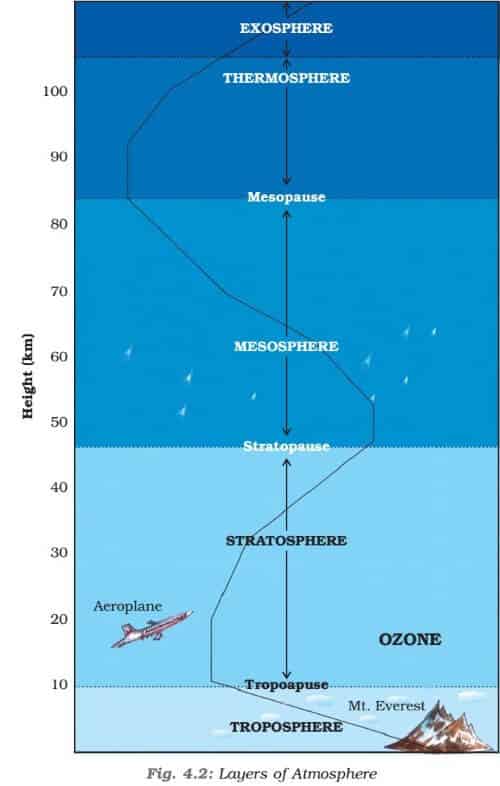
- Troposphere (0 to 12 km): The lowest and densest layer where nearly all weather phenomena—clouds, rain, fog, and storms—occur. Temperature decreases with altitude.
- Stratosphere (12 to 50 km): Free of weather disturbances, making it ideal for flying jet aeroplanes. Houses the ozone layer which filters out harmful solar ultraviolet radiation.
- Mesosphere (50 to 80 km): The coldest atmospheric layer. Incoming meteorites burn up here due to friction with atmospheric gases.
- Thermosphere (80 to 700 km): Temperature rises rapidly with altitude as it absorbs solar X-rays. Contains the ionosphere which reflects radio transmissions back to Earth, and produces auroras.
- Exosphere (> 700 km): The uppermost boundary where light gases like hydrogen and helium escape into space.
3. Which are the four main seasons of India?
- Winter Season (Cold Weather): December to February; marked by low temperatures, clear skies, and calm weather across northern India.
- Summer Season (Pre-monsoon / Hot Weather): March to May; characterized by high temperatures, dry heat, and local dust storms.
- Advancing Monsoon Season (South-West Monsoon): June to September; brings the majority of India's annual rainfall from moisture-laden oceanic winds.
- Retreating Monsoon Season (Post-monsoon): October to November; skies clear across north India while moisture brings rainfall along the south-eastern coast.
4. Why do you not feel the pressure of the atmosphere?
- Internal Counter-Pressure: The blood and internal fluids inside our bodies exert an outward pressure equal to the external air pressure.
- Omnidirectional Balance: Atmospheric pressure presses uniformly from all directions, canceling out the net force on our bodies.
5. In which layer of the atmosphere do aeroplanes fly and why?
- Layer: Aeroplanes fly in the lower portion of the stratosphere (just above the tropopause).
- Reasons:
• Absence of Weather Turbulence: The stratosphere is free of clouds, convective storms, fog, and rain.
• Smooth Flight Conditions: Steady horizontal airflow ensures safety and fuel efficiency.
6. Distinguish between the following: a. The troposphere and stratosphere, b. The south-west monsoon and north-east monsoon.
a. Troposphere vs. Stratosphere:
| Feature | Troposphere | Stratosphere |
|---|---|---|
| Altitude | Extends up to an average height of 12 km. | Extends from 12 km up to 50 km. |
| Temperature | Decreases steadily as altitude increases. | Increases with altitude due to ozone absorption of UV rays. |
| Weather | Site of almost all active weather phenomena (rain, clouds, storms). | Dry, cloudless, and calm; ideal for aircraft. |
b. South-West Monsoon vs. North-East Monsoon:
| Feature | South-West Monsoon | North-East Monsoon |
|---|---|---|
| Active Season | June to September (summer season). | October to February (winter season). |
| Direction of Wind | Blows from oceanic waters toward landmass (sea to land). | Blows from land outward toward the oceans (land to sea). |
| Rainfall Impact | Provides over 75% of total annual rainfall across India. | Largely dry; brings vital winter rains to Tamil Nadu and parts of Andhra Pradesh via Bay of Bengal moisture. |
7. Do it yourself: Table 3.3 shows average monthly temperatures and rainfall for 10 representative stations. Study these figures on your own and convert them into 'temperature and rainfall' graphs. (One such graph for Delhi, Fig. 3.14, is prepared below). Answer questions 7.1 to 7.5 based on the data.
7.1 Stations Re-arranged According to Distance from Equator (Lowest to Highest Latitude):
- Thiruvananthapuram (8°29′N)
- Bengaluru (12°58′N)
- Chennai (13°4′N)
- Mumbai (19°N)
- Nagpur (21°9′N)
- Kolkata (22°34′N)
- Shillong (24°34′N)
- Jodhpur (26°18′N)
- Delhi (29°N)
- Leh (34°N)
7.2 Climatic Extremes and Influences:
- a. Two stations with the most extreme climate: Leh (sub-zero winter temperatures, high altitude) and Delhi / Jodhpur (high annual temperature range between hot summers and chilly winters).
- b. Two stations influenced by retreating / winter monsoons: Chennai and Thiruvananthapuram.
- c. The two hottest stations:
• In February: Thiruvananthapuram (28.7°C) and Chennai (25.7°C).
• In June: Jodhpur (33.9°C) and Delhi (33.3°C).
7.3 Geographic Reasons for Rainfall Variations:
- a. Shillong vs. Kolkata: Shillong sits in the Khasi Hills where moisture-laden Bay of Bengal monsoon winds are funneled and forced upward, causing heavy orographic precipitation compared to low-lying Kolkata.
- b. Delhi vs. Jodhpur: Delhi lies further east along the path of the monsoon trough, while Jodhpur lies in western Rajasthan where monsoon winds have shed most moisture and the Aravalli range aligns parallel to winds without obstructing them.
7.4 Climate Explanations:
- a. Thiruvananthapuram's equable climate: Its coastal location close to the equator grants strong moderating maritime influences with negligible seasonal temperature variation.
- b. Chennai's late rainfall: Chennai lies on the Coromandel coast, positioned in the rain-shadow of the Western Ghats during the south-west monsoon; it receives the majority of its rain between October and December from north-east retreating winds picking up Bay of Bengal moisture.
- c. Leh's moderate precipitation: Leh is located on an elevated plateau enclosed by the Great Himalayas, which block monsoon winds, leaving it in a cold arid rain-shadow zone.
7.5 Monsoon as a Unifying Framework:
- Despite thermal and regional variations, the rhythmic seasonal cycle of the monsoons regulates agricultural rhythms, cultural celebrations, water replenishment, and river systems throughout the entire country.
8. Collect pictures of houses and clothing of people from different regions of India. Examine whether they reflect any relationship with the climatic conditions or the relief of those regions.
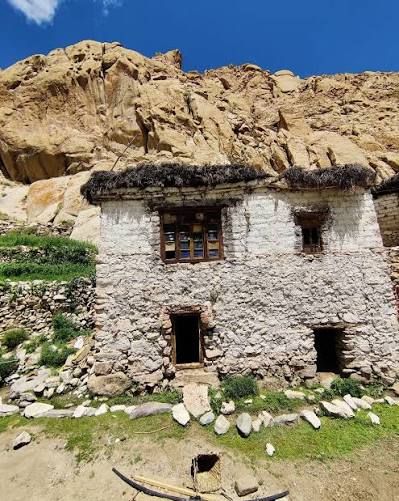
Ladakh: Stone & Mud-Brick House
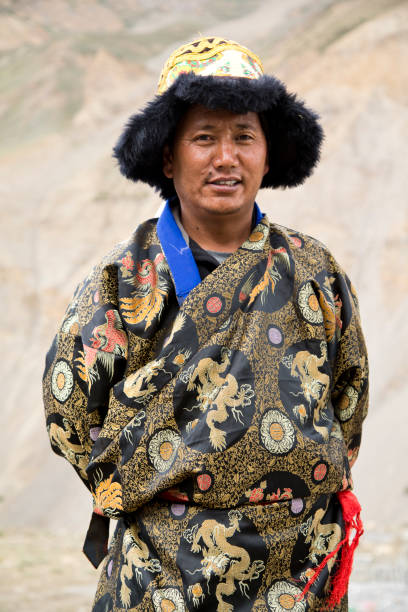
Ladakh: Traditional Woollen Goncha
- Chosen Region: Ladakh (Cold High-Altitude Desert).
- Housing vs. Climate and Relief:
• Houses are built with thick two-storey stone and sun-dried mud-brick walls to trap heat and insulate living areas from sub-zero winter temperatures.
• Roofs are completely flat because Ladakh lies in a rain-shadow zone with minimal rainfall or snowfall; the flat roofs serve as drying platforms for winter food supplies. - Clothing vs. Climate:
• People wear the goncha (a thick, warm woollen robe tied at the waist) made from local sheep and yak wool.
• Heavy woollen caps and boots insulate against extreme freezing winds and prevent frostbite.