Chapter 4: Early Humans and Beginning of Civilisation
Verified step-by-step solutions for your class notes.
1. Do you think life became easier or more challenging after humans started farming? Give two reasons for your answer.
- Life Became More Secure and Predictable: Farming ensured a reliable, localized supply of food through cultivated cereals and domesticated livestock, ending the constant hazard and physical exhaustion of roaming to hunt wild game.
- Life Brought New Demands and Vulnerabilities: Agriculture demanded rigorous year-round manual labor—clearing forests, tilling soil, weeding, and managing irrigation—while making communities vulnerable to famine if seasonal rainfall failed or pestilence wiped out stored crops.
2. The environment offers human societies both opportunities as well as challenges. Explain with reference to early farming communities and river-valley civilisations.
- Environmental Opportunities: River valleys like the Indus, Nile, Tigris-Euphrates, and Huang He provided perpetual supplies of freshwater, naturally fertile alluvial silt renewed by seasonal floods, and navigable waterways for transport and trade.
- Environmental Challenges: Unpredictable, violent flooding could submerge entire settlements, prolonged droughts dried out field crops, and soil exhaustion or marshy diseases threatened community survival, prompting the construction of check dams, canals, and embankments.
3. Why do historians divide early human history into different ages such as Stone Age, Bronze Age, and Iron Age? What does this classification tell us about human progress?
- Reason for Periodisation: The classification is based on the primary raw material used by humans to manufacture their essential tools, implements, and weapons during that historical era.
- Significance for Human Progress: It illustrates humanity's increasing technological mastery over nature—moving from chipping raw stones to smelting metal alloys like bronze, and eventually extracting durable iron, which allowed deeper ploughing, dense forest clearance, and the growth of complex urban civilizations.
4. Imagine you are a Neolithic farmer. Describe one day of your life. What challenges would you face that a hunter-gatherer would not?
- A Day in the Life: Waking up in a sun-dried mud-brick hut, tending to domesticated goats and cattle, weeding the barley plots using polished stone hoes, processing grain with querns, and firing clay pots for storing evening meals.
- Unique Agricultural Challenges: Unlike mobile hunter-gatherers who could follow wildlife when conditions changed, a farmer was bound to one plot of land (sedentism), risking total starvation if pests, drought, or floods ruined the crop.
5. Imagine that the Harappan script gets deciphered tomorrow. What new types of information do you think historians might learn?
- Political and Administrative Structures: Decipherment would reveal whether the Indus cities were ruled by monarchies, priest-kings, or merchant councils, and explain the administrative rules behind their uniform town planning.
- Religious Beliefs and Literature: It would provide direct knowledge of the names of their gods, the purpose of rituals on seals, their mythologies, and specific diplomatic or trade records with West Asian kingdoms like Sumer and Akkad.
6. Prepare a table with three columns—Palaeolithic, Mesolithic, and Neolithic and fill in their distinctive features: tools, settlements, art, and subsistence.
| Feature | Palaeolithic | Mesolithic | Neolithic |
|---|---|---|---|
| Tools | Large stone handaxes, cleavers, choppers, scrapers | Microliths (tiny composite stone points, arrowheads) | Polished stone axes, celts, grinding querns |
| Settlements | Nomadic shelters, natural caves, open river camps | Temporary seasonal camps, rock shelters | Permanent village homes of mud and sun-dried brick |
| Art | Basic body pigments, shell and bone beads | Dynamic rock paintings (e.g., Bhimbetka caves) | Painted pottery, terracotta figures, decorative beads |
| Subsistence | Hunting large wild animals, gathering roots and berries | Hunting small game, fishing, wild grain gathering | Cultivating crops, herding domesticated livestock |
7. "Bronze Age civilisations developed independently but shared common features." Examine this statement with reference to the civilisations given in the chapter.
- Independent River Valley Origins: Civilisations arose in distinct geographical river basins—Sindhu-Sarasvatī along the Indus and Sarasvatī, Mesopotamia along the Euphrates and Tigris, Egypt along the Nile, and China along the Huang He and Yangtze.
- Shared Urban and Economic Features: Each relied on fertile river alluvium for high-yield agriculture, mastered bronze and copper metallurgy, established organized city planning, used standardized weights or measures, and developed early writing systems (like cuneiform, hieroglyphs, or oracle bone script) to regulate administration and trade.
8. Although rivers provided many benefits, they also created challenges for early societies. Discuss both the advantages and disadvantages of settling near rivers.
- Advantages of River Settlements: Rivers provided reliable year-round freshwater, deposited fertile silt (such as kemet in Egypt) during seasonal floods, supported fishing, and served as vital highways for long-distance boat navigation and trade.
- Disadvantages and Hazards: Unpredictable, violent flooding could wash away homes and fields, seasonal drought caused water shortages, shifting river courses left cities stranded, and stagnant waters bred diseases.
9. With the help of your teacher, find out more about the Code of Hammurabi. Why was it important? Do you think it was fair to all sections of society? Give reasons for your answer.
- Importance of the Code: Compiled by King Hammurabi around 1792 BCE in Babylon, it provided a written set of uniform civil and criminal laws inscribed on stone stelae, establishing accountability and serving as a model for future legal systems.
- Fairness Evaluation: It was not equally fair to all social classes. While it offered protections against fraud and malpractice, punishments strictly depended on social hierarchy, imposing harsher physical penalties when crimes were committed against upper-class elites compared to lower-class commoners or enslaved people.
10. If you had to choose one major innovation from early civilisations that changed the world permanently, what would it be and why?
- Major Innovation: The Invention of Writing Systems (such as Sumerian cuneiform, Egyptian hieroglyphs, and Harappan script).
- Global Impact: Writing allowed humans to permanently record knowledge, trade transactions, laws, scientific calculations, and history across generations, moving humanity from prehistory into recorded civilization.
11. Compare the social hierarchy and daily life of people in the Egyptian civilisation with those in Mesopotamia or China. What similarities and differences do you notice?
- Similarities: All three civilisations were deeply stratified with a divine or sacred monarch at the peak (Pharaoh, Mesopotamian Priest-King, or Zhou King with the Mandate of Heaven), supported by nobles/priests, while peasants, artisans, and laborers formed the broad base.
- Differences: Egyptian society placed massive focus on funerary rituals and the afterlife (mummification, building mastabas and pyramids), while Mesopotamia centered public life around city-state temple complexes (ziggurats), and early Chinese society emphasized divination using oracle bones and ancestral bronze rituals. Furthermore, Egyptian women held legal rights to own property and run businesses.
12. Activity: Using maps, locate the major rivers and civilisations of Mesopotamia, Egypt, China, and the Sindhu-Sarasvatī Valley. Mark the trade links between them.
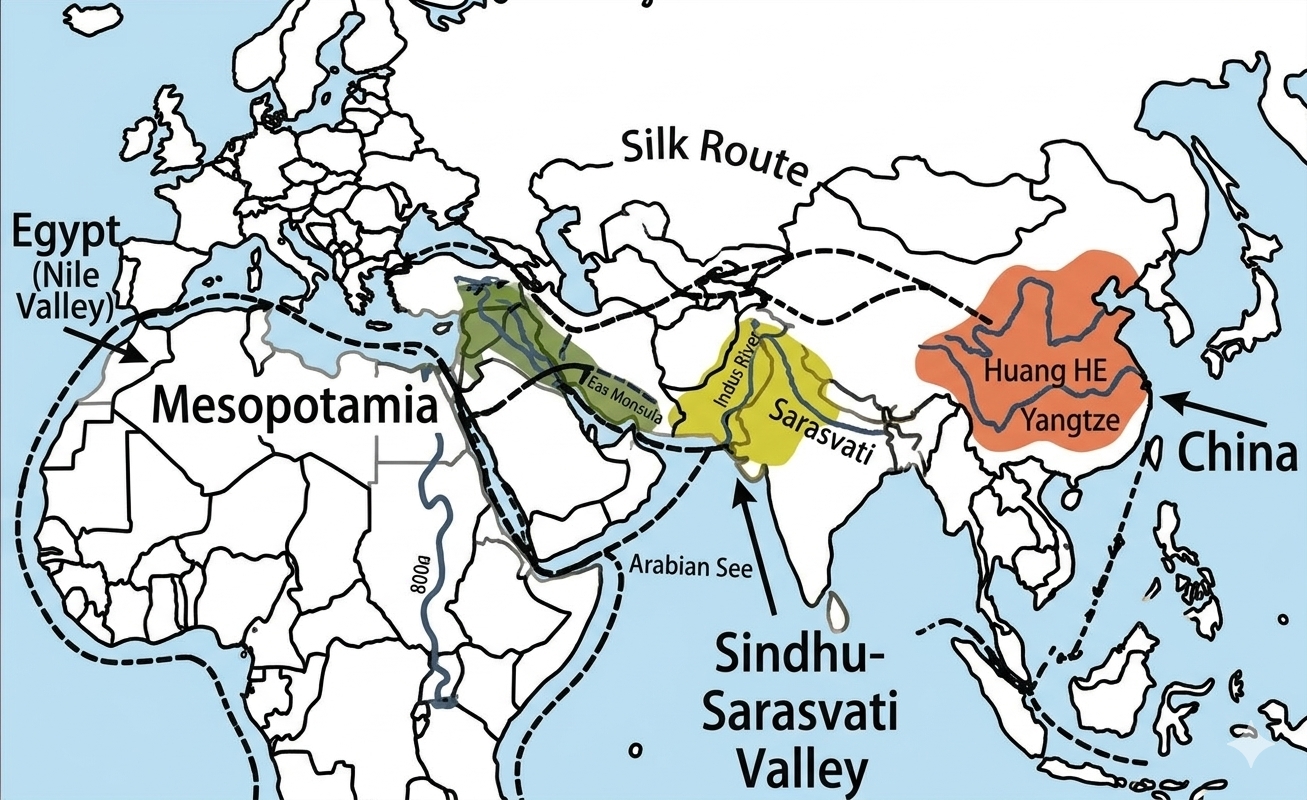
- Major Rivers and Civilisations: Nile River in Egypt, Tigris and Euphrates in Mesopotamia, Indus and Sarasvatī in northwestern India, and the Huang He and Yangtze in China.
- Documented Trade Links: Archaeological and cuneiform records verify regular sea and coastal trade between the Harappan Civilisation (known as Meluhha) and Mesopotamia via intermediary gulf ports of Dilmun (Bahrain) and Magan (Oman), exchanging copper, carnelian beads, ivory, timber, and lapis lazuli .
13. Activity: Choose one early civilisation (Mesopotamia, Egypt, or China) and prepare a mini-scrapbook or a presentation showing their innovations in tools, writing, art, and architecture. Include pictures, brief descriptions, and explain their significance.
- Chosen Civilisation: Mesopotamia (Sumer, Akkad, Babylon).
- Writing (Cuneiform): The world's earliest wedge-shaped script on damp clay tablets, enabling the recording of the Epic of Gilgamesh, administration, and trade accounts.
- Technology & Mathematics: Invented wheeled transport carts, sailboats, canal irrigation systems, the base-60 numbering system, the 60-minute hour, and the 360-degree circle.
- Architecture (Ziggurats): Grand stepped mud-brick tower temples that functioned as holy sanctums, public treasuries, and administrative nerve centers.
- Law & Art (Code of Hammurabi): Carved basalt stone stelae depicting King Hammurabi receiving laws from the justice god Shamash, establishing codified civil standards.