Chapter 5: State and Society upto 1000 CE
Verified step-by-step solutions for your class notes.
1. How did political organisation change from the Vedic period to the age of large empires such as the Mauryas and the Guptas? Explain the administrative system of the early Indian states.
- Shift in Political Formations: Governance initially revolved around tribal, lineage-centered units (janas) led by chiefs. With sedentary agriculture taking hold, territorial identities (janapadas) emerged and eventually consolidated into sixteen larger realms (mahājanapadas), which culminated in vast imperial polities like the Mauryan and Gupta realms.
- Administrative Setup: The monarch presided over the apparatus with help from a ministerial council (mantri-parishad). Governance operated across layered tiers, dividing territories into provinces (termed bhuktis or mandalams), divisions and districts (vishayas or nādus), down to local villages directed by headmen (grāmikas) and councils.
2. Describe the role of the king, important officers, and the methods used to govern large territories.
- Responsibilities of the Ruler: The monarch was tasked with securing borders against outside incursions, keeping internal stability, running judicial systems, and commissioning vital public initiatives such as reservoir networks.
- Key Functionaries: Administration depended on trusted advisers and functionaries (amātyas), military commanders, finance overseers, tax executives, and diplomats like the Gupta-era foreign affairs officer (sāndhivigrahika).
- Methods for Broad Control: Monarchs distributed territorial supervision across provinces and districts, posted regional governors (pradeśhikas), collaborated with town guild dignitaries, and maintained transit corridors.
3. After studying this chapter, what do you think were the most important features of the state and society in India before 1000 CE?
- Ethical Frameworks: Sovereignty and daily living were shaped by philosophical notions of righteousness (dharma), cosmic order (rita), and spiritual equality (samatva).
- Self-Sustaining Local Councils: Grassroots administration functioned through autonomous village committees and professional merchant associations (shreṇīs) that settled disputes, managed public property, and funded civic needs.
- Vibrant Cultural Intercourse: The civilization supported wide-ranging overland and oceanic commerce (Uttarāpatha, Dakshiṇāpatha), residential centers of higher learning, and evolving social customs.
4. What do early texts such as the Rigveda, Arthashastra, and the Mahābhārata reveal about political and social life?
- Rigveda: Documents an early kinship-driven community featuring collective assemblies (sabhā, samiti, vidhata) and flexible trade pursuits within single households.
- Arthashastra: Sets forth a structured doctrine of pragmatic administration focused on the seven pillars of polity (Saptāṃga), state revenue monitoring, and economic enterprise.
- Mahābhārata: In the Shanti Parva, it explores the ruler’s ethical burden to guard society, dispense impartial justice, and sustain collective social wellbeing.
5. What can we learn from early Indian society about varna and the role of women?
- Varna Arrangement: Initial classifications were functional divisions of duties rather than inherited identities at birth, permitting mobility across occupational roles.
- Standing of Women: In early periods, women accessed education, composed sacred hymns (such as Lopamudra and Ghoshā), and took part in public congregations. Even with later cultural constraints, royal women like Prabhāvatī Gupta exercised political regency, and southern records celebrate female bards, traders, and cultural donors.
6. Explain how assemblies like sabhā and samiti limited the power of the rājā. Which modern institutions perform similar functions today?
- Checks on Chieftain Authority: The sabhā served as an elder council handling legal verdicts, while the samiti served as a popular gathering for collective political decision-making, restraining unilateral ruler actions.
- Contemporary Parallels: Modern parliamentary chambers and constitutional supreme courts operate with comparable oversight to keep executive heads of state accountable.
7. What do the terms varṇa and jāti refer to in early Indian society? How were they different, and what factors may have contributed to the formation of various jātis?
- Distinction: Varṇa designated the overarching four-part functional template (Brāhmaṇa, Kshatriya, Vaishya, Shūdra), whereas jāti represented numerous regional, endogamous communities centered on trades.
- Factors of Formation: Proliferation occurred due to cross-community family unions, the conversion of trade guilds into localized social networks, migratory influxes, and the incorporation of forest societies into agricultural regions.
8. Why do you think education in early India emphasised both knowledge and moral values? How might this have benefited society?
- Purpose of Integrated Learning: Classical instruction nurtured technical expertise alongside ethical virtues—self-restraint, respect, and duty—to prepare students for responsible community life.
- Societal Benefit: Grounding students in civic duty ensured administrators, scholars, and merchants performed their trades with honesty, reinforcing social harmony and institutional stability.
9. Look at the major trade routes of early India (Fig 5.12). How do you think these routes helped people in the exchange of goods, skills, beliefs, and cultural practices?
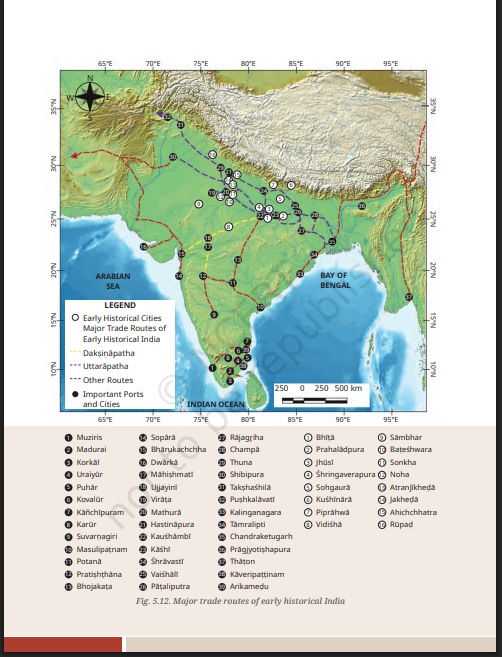
- Commercial Integration: The northern Uttarāpatha and southern Dakshiṇāpatha channels connected inland trading towns with coastal ports, facilitating traffic in textiles, spices, metals, and gemstones.
- Cultural and Intellectual Exchange: These highways enabled traveling monks, craftspeople, and academics to share architectural methods, philosophical ideas, and literary traditions across different regions.
10. What might have been the advantages and challenges of ruling a large empire in the absence of modern communication systems?
- Advantages: Access to rich, varied regional revenues, diverse agricultural produce, long-distance tolls, and high strategic power against external invaders.
- Challenges: Travel delays in relaying imperial commands across distances, risks of local rebellion or corruption among regional officials, and the continuous expense of garrisoning frontier zones.
11. Many ideas about governance come from texts composed by scholars and advisors of the king. What might be some limitations of relying only on such sources?
- Elite Theoretical Lens: Works like the Arthashastra or royal edicts depict prescribed ideals rather than day-to-day realities experienced by ordinary subjects.
- Absence of Subaltern Voices: Court texts minimize perspectives from marginal groups, agricultural laborers, and lower artisanal strata, making corroboration with archaeology, copper-plate records, and folk accounts necessary.
12. Read the source and answer the questions (Nashik cave inscription of Ushavadāta):
a. What does this source tell us about the economic role of guilds?
b. Why were guilds trusted with money deposits?
c. Identify the donor and the donees from the given source.
- a. Economic Function: Demonstrates that guilds (shreṇīs) ran financial operations, took cash deposits, and paid recurring interest to fund designated endowments.
- b. Public Trust: Guilds were trusted due to their internal peer courts, durable trade output, and long-standing solvency, which ensured reliable returns on endowments.
- c. Parties Involved: The donor was Ushavadāta (son-in-law of King Nahapāna); the beneficiaries were the monastics residing in the cave complex.
13. Mark and locate on the map of India the following important centres: Pāṭaliputra, Nāśhik, Ujjayinī, Vikramśhila, Kānchipuram, Mathurā, Rājgriha.
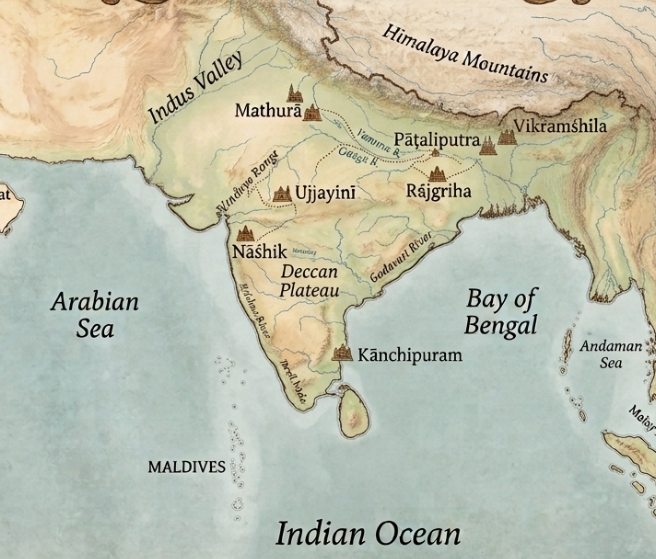
- Location Guide for Outline Map of India:
• Pāṭaliputra: Modern Patna, along the south bank of the Ganga in Bihar.
• Nāśhik: Western Maharashtra, along the upper Godavari River basin.
• Ujjayinī: Malwa plateau in modern Madhya Pradesh.
• Vikramśhila: Near modern Bhagalpur in eastern Bihar.
• Kānchipuram: Northern Tamil Nadu, southwest of Chennai.
• Mathurā: Western Uttar Pradesh, along the Yamuna River.
• Rājgriha: Modern Rajgir, Nalanda district in Bihar.
14. Prepare a short presentation or poster on one of the following: a. Life in the Vedic society, b. Early education system (gurukula), c. Trade and guilds in early India, d. Role of women in early Indian society.
- Guru-Shishya Paramparā: The preceptor (guru) guided pupils from ignorance to understanding within a close family setting that demanded discipline, simplicity, and mutual respect.
- Comprehensive Knowledge Base: Education integrated intellectual studies (Vedas, logic, astronomy, mathematics, medicine) with physical training, arts, and crafts.
- Guiding Ethical Mission: The system emphasized dharma, character development, inner purity, and duty toward family and community over mere career advancement.
15. Divide the class into three groups. Each group will work on one project (water, wind, and glacier). The project should highlight the causes, impact on human life and the environment, and mitigation measures.
- Group 1 – Running Water: Triggered by excessive rains and shifting stream beds; causes loss of arable land and damaged settlements; mitigated by bund construction, check dams, and hillside afforestation.
- Group 2 – Wind: Occurs in dry terrains through soil exposure and storms; leads to desertification and health concerns; addressed through windbreaks, shelterbelts, and sand-fixation planting.
- Group 3 – Glaciers: Driven by warming and weakening moraine lake barriers (GLOFs); threatens downstream river valleys; managed through satellite tracking, flow sensors, and controlled lake drainage.